
Transforming your garden, farm, or lifestyle block from a bare patch of land into a lush, established haven can feel like a waiting game. Whether you're seeking a natural privacy screen, a robust shelterbelt to protect against the southerlies, or aiming to tackle erosion on a tricky slope, the right trees can achieve your goals in surprisingly little time. Many assume that 'fast-growing' means compromising on quality or longevity, but that couldn't be further from the truth. New Zealand's temperate climate is a perfect host for a diverse range of rapid growers, from valuable timber species to soil-stabilising heroes.
This guide moves beyond the obvious choices, providing detailed, practical insights into eight of the best fast growing trees New Zealand conditions can support. We will explore not just how fast they grow, but where they thrive, their unique benefits, and the specific care they need to reach their full potential. Making a smart choice now means you get a long-term investment that pays off quickly, both in terms of visual appeal and practical function.
Beyond providing privacy and shelter, planting fast-growing trees also contributes significantly to environmental efforts aimed at reducing your carbon footprint. This list will help you select the ideal species to meet your specific landscaping goals, ensuring rapid growth and long-term success.
1. Eucalyptus (Eucalyptus species)
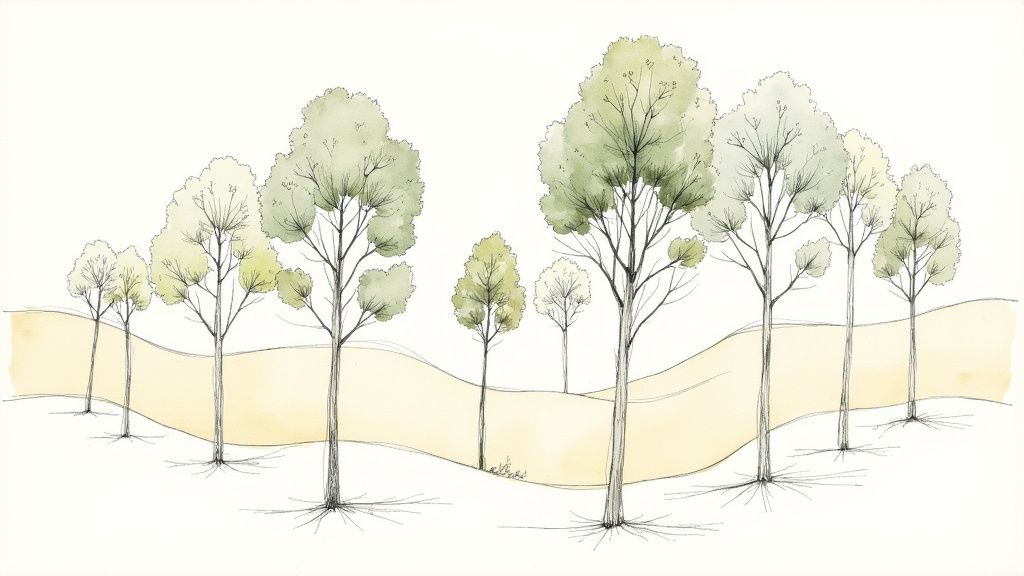
Originally from Australia, Eucalyptus trees are celebrated as some of the fastest-growing hardwoods available in New Zealand. These evergreen giants have adapted exceptionally well to our varied climates, making them a cornerstone for forestry, farming, and land management projects. Some species, like Eucalyptus nitens (Shining Gum), are capable of astonishing growth, potentially reaching over 20 metres in just 10 years under ideal conditions.
Their rapid growth makes them invaluable for timber production, with companies like Juken New Zealand operating extensive plantations. Beyond commercial forestry, their dense foliage and robust nature make them a top choice for creating effective shelter belts, a common sight on farms throughout Canterbury and Otago, protecting stock and crops from harsh winds.
Why Choose Eucalyptus?
Eucalyptus trees are chosen for projects demanding quick results. They are a go-to for erosion control, particularly in vulnerable areas like the East Coast of the North Island, where their deep, binding root systems stabilise soil effectively. Furthermore, their high growth rate translates to rapid carbon sequestration, making them a favoured species for carbon farming schemes under initiatives like the Permanent Forest Sink Initiative.
Actionable Tips for Planting
To ensure your Eucalyptus thrives, follow these key steps for successful establishment and growth:
- Species Selection: Match the species to your region. E. nitens is well-suited for cooler, frost-prone areas, while species like Eucalyptus saligna (Sydney Blue Gum) prefer warmer, northern climates.
- Planting Time: Plant seedlings in spring after the last frost has passed to give them a full growing season to establish before their first winter.
- Spacing: For a dense shelter belt, space trees 2-3 metres apart. For timber production where larger trunks are desired, increase spacing to 4-6 metres.
- Early Care: In the first two years, ensure consistent moisture to help the root system develop. Young trees in exposed locations will also benefit from temporary shelter or staking to prevent wind damage.
2. Radiata Pine (Pinus radiata)
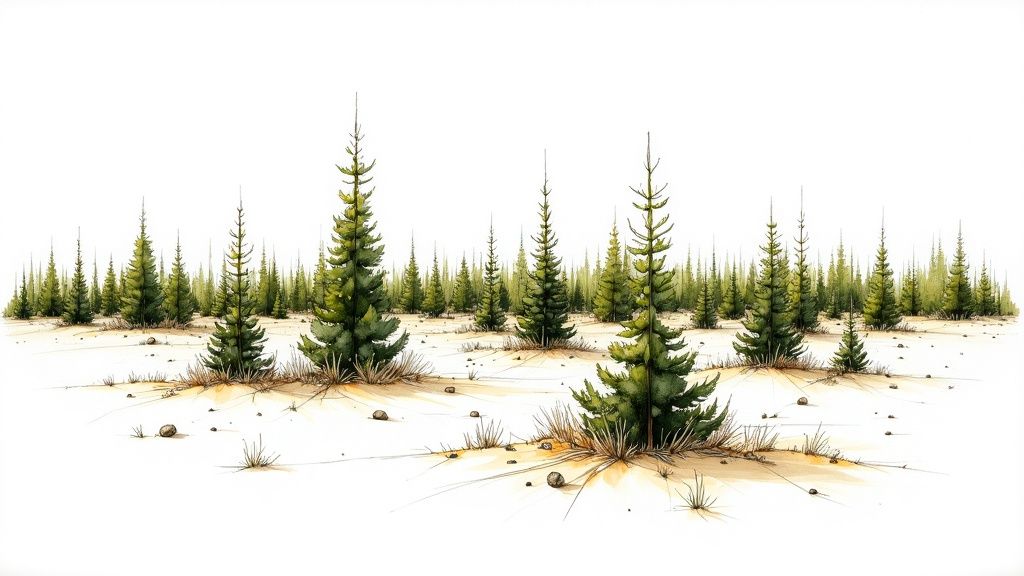
Originally from a small coastal area in California, Radiata Pine has become New Zealand's definitive forestry tree, dominating our commercial plantations. It comprises approximately 90% of the country's planted forest area, a testament to its incredible adaptability and growth rate in the New Zealand climate, where it often outperforms its native counterparts. This robust conifer is the cornerstone of a multi-billion dollar industry, reaching a harvestable size in just 25 to 30 years.
Its rapid growth and versatile timber make it a primary choice for a huge range of applications, from structural lumber to pulp and paper. Vast plantations like the Kaingaroa Forest near Rotorua demonstrate its scale, but it's equally valuable for small-scale farm forestry blocks and for stabilising land. Its effectiveness in erosion control has been proven in regions like the Gisborne/East Coast, helping to bind vulnerable soil after storm events.
Why Choose Radiata Pine?
Radiata Pine is chosen for its unparalleled economic return and rapid timber production, making it one of the most reliable fast-growing trees in New Zealand for commercial ventures. Its predictable growth cycles and well-established management practices, championed by organisations like the New Zealand Forest Owners Association, provide a secure investment. Beyond large-scale forestry, its quick establishment makes it suitable for creating shelter, sequestering carbon, and providing a future timber resource on lifestyle blocks and farms.
Actionable Tips for Planting
For a successful Radiata Pine plantation, whether large or small, precise management is key. Follow these industry-standard practices:
- Genetic Stock: Always purchase genetically improved seedlings from a reputable nursery. This ensures faster growth, better form, and improved disease resistance.
- Planting Density: For timber production, aim for a density of 1000-1200 stems per hectare. This encourages straight growth before the first thinning.
- Pruning: To produce high-value clearwood (timber without knots), prune the lower branches in stages. This is typically done over the first 5-8 years to a final height of about 6 metres.
- Thinning: Undertake thinning operations to reduce competition and allow the best trees to grow larger. A typical schedule involves thinning at years 6-8 and again around years 12-14.
3. Macrocarpa (Cupressus macrocarpa)
Originally from California's Monterey Peninsula, Macrocarpa has become one of New Zealand’s most recognisable fast-growing trees since its introduction in the 1850s. This coniferous evergreen is renowned for its rapid growth, especially in coastal and inland areas where it thrives. Young trees display a classic conical shape, which broadens into a spreading, majestic canopy at maturity, making it a dramatic feature in any large-scale landscape.
Its popularity stems from its dual-purpose nature. The dense foliage provides excellent shelter, leading to its widespread use in historic windbreaks seen throughout rural Canterbury and Otago. Simultaneously, it produces a highly valued, naturally durable timber with an attractive grain, sought after by specialist craftspeople for furniture and outdoor structures. Its adaptability makes it suitable not just for farms, but also as an ornamental feature in urban parks across Wellington and Auckland.
Why Choose Macrocarpa?
Macrocarpa is the ideal choice for creating robust, long-lasting shelter with remarkable speed. Its dense evergreen foliage forms an impenetrable barrier against harsh winds, crucial for protecting stock, crops, or even more delicate native plantings on exposed hill country farms. The timber is naturally resistant to rot and insects, making it a sustainable, untreated option for everything from fence posts to high-end furniture. Its impressive salt tolerance, demonstrated by naturalised populations at Cape Foulwind on the West Coast, also makes it a top contender for coastal landscaping projects.
Actionable Tips for Planting
For a successful Macrocarpa planting, consider these practical recommendations for establishment and long-term health:
- Cultivar Selection: Choose canker-resistant cultivars like ‘Brunniana Gold’ or ‘Greenstead Magnificent’, especially in warmer, more humid regions where the disease is more prevalent.
- Spacing: For an effective shelter belt, space trees 3-5 metres apart. This allows their canopies to interlock and form a solid wall of foliage. You can explore a variety of fast-growing hedges in NZ for different screening options.
- Site Selection: Plant on deep, well-drained soils and avoid frost pockets, as young trees are particularly vulnerable to heavy frosts.
- Maintenance: Prune any dead or damaged branches promptly to minimise the risk of canker disease establishing itself. This simple act is crucial for maintaining the tree’s vigour.
4. Poplar (Populus species)
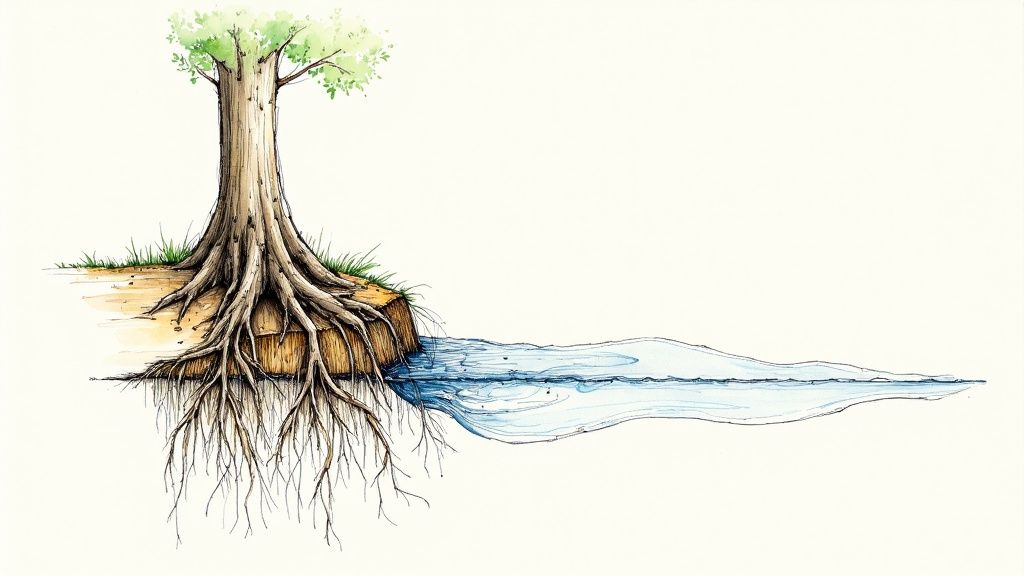
Poplars are renowned as one of the fastest-growing deciduous trees in New Zealand, valued for their remarkable versatility and rapid establishment. Capable of growing 2-3 metres per year in ideal conditions, these hardy trees are a cornerstone of soil conservation efforts, particularly on steep, erosion-prone hill country. Numerous species and hybrids are grown here, including Lombardy poplar (P. nigra 'Italica') and specialised cultivars developed by the New Zealand Poplar and Willow Research Trust.
Their extensive use in erosion control programmes is evident across regions like Gisborne and Manawatū, where thousands of poplar poles are planted annually to stabilise slopes. They are also widely used for creating effective farm shelter belts and in riparian planting schemes along waterways in areas such as Hawke's Bay, helping to protect banks and improve water quality. Their rapid growth makes them a key tool for sustainable land management.
Why Choose Poplar?
Poplars are the tree of choice for urgent soil conservation and land stabilisation projects. Their ability to be planted as large poles allows them to establish quickly and develop a strong, fibrous root system that binds soil particles together, preventing slips and reducing sediment runoff. This makes them indispensable in many North Island hill country farming systems. Beyond erosion control, their fast growth also provides quick shade and shelter for stock.
Actionable Tips for Planting
To maximise the success of your poplar planting, particularly for erosion control, consider these specialised techniques:
- Planting Method: Use poles (2-3 metre long cuttings) planted directly into the ground during the winter or early spring dormant period.
- Spacing for Erosion Control: For effective slope stabilisation, space poles 10-15 metres apart in a grid or diamond pattern across the hillside.
- Variety Selection: Consult with your regional council or the New Zealand Poplar and Willow Research Trust to choose cultivars best suited to your specific climate and soil type.
- Weed Control: Immediately after planting, apply a contact herbicide or use a weed mat at the base of each pole to eliminate grass competition, which is crucial for early survival and growth.
- Planting Depth: In drier regions or on north-facing slopes, plant poles deeper (up to 1.2 metres) to ensure the base reaches more reliable soil moisture.
5. Douglas Fir (Pseudotsuga menziesii)
A premium conifer from western North America, Douglas Fir has established itself as a valuable and highly sought-after forestry species in New Zealand. While not as explosively fast as Radiata Pine, its steady growth rate of around 0.8 to 1.2 metres per year is impressive, especially when paired with the superior quality and strength of its timber. This makes it one of the more desirable fast growing trees New Zealand foresters are turning to for high-value production.
Its resilience and adaptability have led to successful plantations in cooler, high-rainfall regions across the country, from the Nelson and Tasman regions to the Canterbury high country and Southland. Douglas Fir timber commands a premium price, particularly in export markets like Japan for traditional construction, and is less susceptible to many of the pests that affect pine. This combination of strong growth and high-value, durable timber makes it an excellent long-term investment.
Why Choose Douglas Fir?
Douglas Fir is chosen by growers looking beyond sheer speed to focus on timber quality, strength, and market value. It is an ideal alternative for landowners wanting to diversify their forestry assets away from a single species. Its performance in cooler, wetter climates where other species might struggle makes it a strategic choice for specific sites. The long-term economic returns from its high-grade timber are a primary driver for its selection in commercial forestry ventures.
Actionable Tips for Planting
To cultivate a successful Douglas Fir plantation, careful planning and site selection are crucial for this long-rotation species:
- Site and Variety Selection: It thrives in regions with over 1000mm of annual rainfall. Choose the 'coastal' variety for milder areas or the 'interior' variety for sites with heavier frosts.
- Planting Density: Plant seedlings at an initial density of 800-1000 stems per hectare to encourage straight growth.
- Thinning and Pruning: Thin the stand around year 10-12 to a final density of 400-500 stems per hectare. Prune the best final crop trees up to a height of 6-8 metres to produce clear, knot-free timber.
- Animal Protection: Young Douglas Fir seedlings are highly palatable to browsing animals like deer and rabbits, so ensure robust protection during the establishment phase. While it is a great choice for forestry, if you're looking to create a more diverse habitat, you can integrate it with a NZ native garden.
6. Black Walnut (Juglans nigra) and Hybrid Walnuts
Black Walnut and its hybrid varieties represent a premium, long-term investment among New Zealand's faster-growing hardwoods. While not matching the sheer speed of pines or eucalypts, they offer a respectable growth rate of 0.6 to 1 metre per year and produce exceptionally valuable, dark-grained timber coveted by furniture makers and for high-end veneers.
This species provides a unique dual-value proposition, capable of producing both sought-after nuts and high-quality timber. Hybrid varieties, often crosses between Black Walnut (Juglans nigra) and English Walnut (Juglans regia), are gaining popularity for their improved growth rates, timber form, and adaptability to NZ conditions. They are a feature of agroforestry systems, particularly in the Canterbury Plains where they are integrated with sheep grazing, and in specialty plantations across the Waikato and Marlborough.
Why Choose Walnuts?
Walnuts are chosen for their high-value timber, which commands premium prices, making them an excellent long-term asset. They are ideal for landowners looking to diversify with a specialty species that appreciates significantly over time. The NZ Farm Forestry Association and the NZ Walnut Industry Group actively promote walnuts as a high-value alternative to traditional forestry, suitable for small-scale high-value plots and larger agroforestry projects.
Actionable Tips for Planting
To cultivate high-quality walnut trees, a strategic approach from the outset is crucial for this long-term project:
- Species Selection: Source improved hybrid varieties from reputable nurseries to ensure good genetics for timber form and growth. The NZ Walnut Industry Group is a key resource for this.
- Planting Site: Choose deep, well-drained alluvial soils, ideally at least 1.5 metres deep. Walnuts will not tolerate waterlogged or compacted sites.
- Spacing: For combined nut and timber production, space trees widely at 8-12 metres apart. This allows for full crown development and easier management.
- Early Care: Prune young trees meticulously to establish a straight, clear trunk of at least 5-6 metres. Protect saplings from stock browsing for the first 3-5 years using tree guards. You can learn more about the general care of fruiting trees in New Zealand.
7. Red Alder (Alnus rubra)
Red Alder is a fast-growing deciduous hardwood native to the Pacific coast of North America that is gaining significant attention in New Zealand. Prized for its rapid growth of 1 to 1.5 metres per year, it offers a sustainable forestry alternative, often reaching a harvestable size in just 20 to 30 years. This is exceptionally quick for a quality hardwood, making it an exciting prospect for timber and land management.
Its most remarkable trait is its ability to fix nitrogen in the soil through a symbiotic relationship with bacteria in its root nodules. This natural fertilisation process improves soil fertility, making Red Alder invaluable for rejuvenating degraded land. It's increasingly used in agroforestry systems and land rehabilitation projects, particularly on the West Coast, where its soil-improving qualities and strong root systems help stabilise erosion-prone land.
Why Choose Red Alder?
Red Alder is a superb choice for projects focused on ecological restoration and sustainable timber. Its ability to thrive on poor, disturbed soils makes it a pioneer species for kick-starting forest regeneration. Organisations like Scion Research are exploring its potential within NZ forestry, while regional councils utilise it for landslip rehabilitation and improving riparian zones in areas like Waikato and Taranaki. The timber is also highly valued for furniture and cabinetry, providing a sustainable alternative to imported hardwoods.
Actionable Tips for Planting
To successfully cultivate Red Alder and harness its unique benefits, consider the following practical advice:
- Site Selection: Plant in high-rainfall areas, as Red Alder thrives with over 1200mm of annual rainfall. It’s ideal for riparian strips, wetland margins, and degraded sites needing soil improvement.
- Spacing: For biomass or as a nurse crop, space seedlings 2-3 metres apart. For quality timber production, increase spacing to 3-5 metres to allow for larger trunk development.
- Early Management: Prune lower branches in the early years to develop a clear, straight stem, which significantly increases its value as sawlog timber.
- Soil Improvement: Use Red Alder as a nurse crop to enrich the soil with nitrogen before planting more valuable, long-term species that will benefit from the improved conditions.
8. Willow (Salix species)
Renowned for their vigorous growth, Willows are among the fastest-growing trees in New Zealand, with some varieties capable of growing an incredible 2-4 metres in a single season. These adaptable trees thrive in moist conditions, making them a primary tool for soil conservation and waterway management across the country. Like poplars, they are typically established from poles (large cuttings), which allows for rapid, cost-effective planting on a large scale.
Willows are the backbone of many successful erosion control programmes, especially in vulnerable regions. In the Gisborne and East Coast districts, they are planted alongside poplars to stabilise vast areas of erodible hill country. Similarly, they are used extensively in Manawatū and Hawke's Bay to reinforce river banks and prevent landslips, showcasing their critical role in protecting valuable agricultural land and infrastructure.
Why Choose Willow?
Willows are chosen for their unparalleled ability to establish quickly and form dense, fibrous root systems that bind soil particles together. This makes them indispensable for stabilising stream banks, gullies, and areas prone to slipping. The New Zealand Poplar and Willow Research Trust has developed specific cultivars tailored to our unique environmental challenges, ensuring there is a suitable willow for almost any soil conservation task, from large-scale hill country stabilisation to riparian planting schemes.
Actionable Tips for Planting
To maximise the effectiveness of willows for land management, follow these proven techniques developed for New Zealand conditions:
- Planting Method: Use poles 2-3 metres long, planting them 1-1.5 metres deep during the dormant winter season (June-August). This ensures the pole is anchored securely and has access to moisture.
- Species Selection: Choose the right type for the job. Tree willows like Salix matsudana x alba are ideal for stabilising large landslips, while shrub willows are better suited for smaller gullies and stream edges.
- Spacing: For gully and stream bank projects, space poles 3-5 metres apart. Plant them across the slope, leaning slightly uphill, to create an immediate barrier against soil and water movement.
- Regional Advice: Contact your local regional council. Many offer free or subsidised willow poles and provide expert advice on which species are best for your specific area and erosion problem.
Fast-Growing Trees Comparison: Top 8 NZ Species
| Species | Implementation Complexity 🔄 | Resource Requirements ⚡ | Expected Outcomes 📊 | Ideal Use Cases 💡 | Key Advantages ⭐ |
|---|---|---|---|---|---|
| Eucalyptus (Eucalyptus species) | Moderate: Species selection and pruning needed | Moderate water early on; low maintenance after establishment | Rapid growth (1.5-2.5 m/year), good timber and carbon sequestration | Timber, shelter belts, erosion control, carbon farming | Fast growth, drought tolerance, valuable timber |
| Radiata Pine (Pinus radiata) | High: Requires professional management, thinning, pruning | High: Intensive silviculture and access infrastructure | Reliable timber yield (~25-30 years harvest), strong commercial returns | Commercial forestry, erosion control, furniture | Proven commercial success, versatile timber, carbon sequestration |
| Macrocarpa (Cupressus macrocarpa) | Moderate: Disease management needed (canker), longer rotations | Moderate: Low maintenance, disease management required | Moderate growth (1-1.2 m/year), durable timber in 40-60 years | Coastal shelter belts, decorative planting, long-term timber | Durable rot-resistant timber, salt tolerance, coastal suitability |
| Poplar (Populus species) | Low: Easy propagation by poles, simple planting | Low: Poles inexpensive, minimal maintenance | Very fast growth (2-3 m/year), erosion control, short rotation | Erosion control, riparian zones, biomass crops | Fastest growth, excellent erosion control, low establishment cost |
| Douglas Fir (Pseudotsuga menziesii) | High: Longer rotation, thinning and pruning required | High: Expensive establishment, deer/possum protection | Moderate growth (0.8-1.2 m/year), premium timber in 40-50 years | Cooler regions, premium timber production, alternative to pine | High-quality wood, pest resistance, export demand |
| Black Walnut (Juglans nigra) & Hybrids | High: Long-term management, wide spacing, nut and timber crops | High: Fertile soil needed, high establishment cost | Slow growth (0.6-1 m/year), dual income from nuts and timber | High-value hardwood timber, agroforestry, nut production | Premium timber, dual income, attractive grain, agroforestry compatibility |
| Red Alder (Alnus rubra) | Moderate: Short rotation hardwood, nitrogen-fixing benefits | Moderate: Suited for poor soils, prefers moist sites | Fast hardwood growth (1-1.5 m/year), soil improvement, timber in 25-35 years | Land rehabilitation, agroforestry, short rotation hardwood | Nitrogen fixation, fast hardwood growth, soil restoration |
| Willow (Salix species) | Low: Easy rapid establishment from poles, frequent management | Low: Low cost, poles often subsidized | Extremely fast growth (2-4 m/year), excellent erosion control | Streambank stabilization, erosion control, biomass | Fastest establishment, tolerates wet soils, low cost, erosion control |
Choosing Your Future Forest: The Next Steps
Planting a tree is an act of optimism, and choosing a fast-growing species is a way to see that future arrive more quickly. This guide has explored a diverse range of rapid growers, from the towering commercial strength of Radiata Pine and Douglas Fir to the elegant, soil-stabilising grace of Poplars and Willows. We have seen how species like Eucalyptus can provide rapid shelter and firewood, while others, such as Black Walnut, represent a long-term investment in high-value timber. Each of these trees offers a unique set of benefits, but their success hinges entirely on one crucial factor: matching the right tree to the right place.
The journey from a bare paddock to a thriving stand of trees begins with careful planning and assessment. Before you even think about digging a hole, take the time to deeply understand your specific environment. Consider the unique microclimate of your property, paying close attention to soil composition, average rainfall, exposure to prevailing winds, and the severity of local frosts. These elements are the fundamental building blocks of success when cultivating fast growing trees in New Zealand. An informed choice today prevents disappointment tomorrow and ensures your trees not only survive but truly flourish, transforming your landscape for decades to come.
Actionable Next Steps for Your Planting Project
With this knowledge in hand, your path forward becomes clearer. Here are the practical steps to turn your vision into a reality:
-
Refine Your Goals: What is the primary purpose of your planting? Are you seeking a fast-establishing shelterbelt, a sustainable source of firewood, erosion control for a hillside, or a future timber harvest? Your answer will immediately narrow down the best options from our list. For example, a Red Alder is an excellent choice for improving soil, but a Macrocarpa might be better for a dense, formal hedge.
-
Consult Local Experts: Don’t underestimate the power of local knowledge. For larger-scale projects or complex sites, connecting with your regional council or the New Zealand Farm Forestry Association can provide invaluable, site-specific advice. They often have insights into local pests, soil deficiencies, and which species perform best in your specific catchment area. As you consider the long-term planning involved in selecting and cultivating trees, expanding your knowledge through agricultural education grants can be immensely valuable for success.
-
Source High-Quality Saplings: The health and vigour of your saplings will have a significant impact on their establishment and growth rate. Seek out reputable nurseries that provide well-rooted, healthy specimens suited to your region. This initial investment in quality stock pays dividends in faster growth and greater resilience.
By making a deliberate and well-researched choice, you are doing more than just planting a tree; you are investing in the future health, shelter, and value of your land. You are creating a legacy that will provide shade, support ecosystems, and enhance the environment for years to come.
Ready to find the perfect saplings to start your green legacy? Explore the curated collection of outdoor trees and landscaping plants on Jungle Story. We connect you with trusted New Zealand sellers offering high-quality, healthy specimens to ensure your fast-growing trees get the best possible start.