
When you hear "landscape design," you might think it's just about planting a few shrubs and calling it a day. But it’s so much more than that. It’s the art of creating an outdoor space that’s not only beautiful but also truly works for you and your family. It's a blend of smart planning, a bit of horticultural know-how, and your own personal flair, all coming together to turn a patch of land into a genuine extension of your home.
What Do You Really Want From Your Garden?
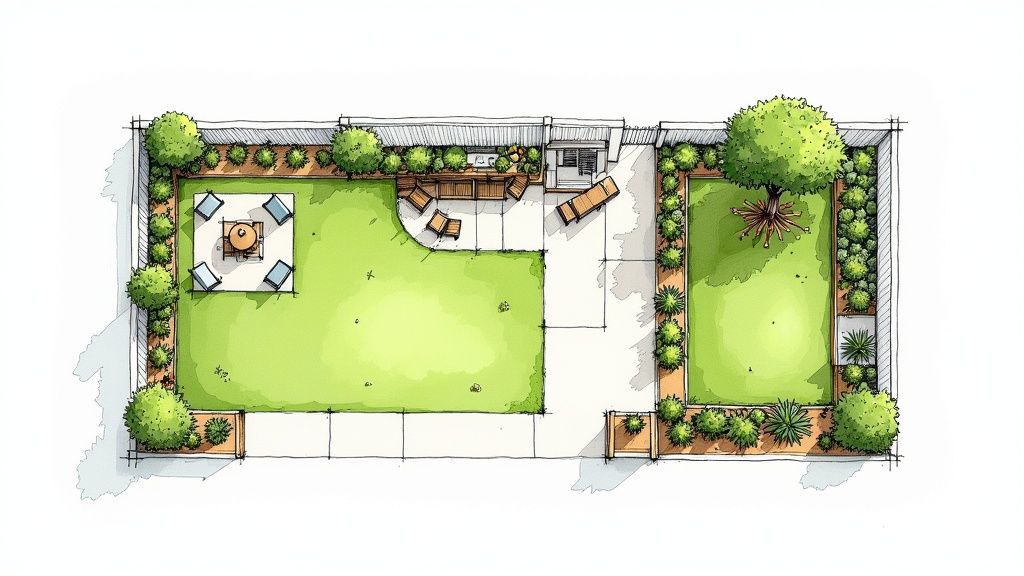
Before you even think about lifting a shovel, the most important thing you can do is get a crystal-clear picture of your ideal garden. Seriously, what do you want this space to do? This vision becomes your North Star, guiding every single decision, from the plants you pick to where you lay the pavers.
Without this thinking upfront, it's easy to end up with a random jumble of plants and features that don't quite connect. I've seen it happen: someone invests a heap of time and money on a stunning paved patio, only to realise what their family actually needed was a flat bit of lawn for the kids to run around on. Nailing down your goals from the start saves a lot of headaches (and money!) later on.
Marrying Function with Your Personal Style
Take a moment to think about how you live. Your garden should feel like it belongs to your home and fits your lifestyle. Are you dreaming of a social hub for summer barbies, with a big deck and a tough-as-nails lawn? Or is your ideal a quiet, private sanctuary where you can sip your morning coffee surrounded by greenery?
Maybe you're all about practicality, picturing a thriving veggie patch that keeps your kitchen stocked with fresh produce. And hey, you can absolutely have a mix of these! The trick is to figure out what's most important to you.
A truly great garden isn't just about what you see; it's about how it makes you feel and what it lets you do. The secret to an outdoor space you'll love for years is finding that perfect balance between how you want to use it and the look you're after.
Finding Your Vibe in Kiwi Garden Styles
One of the best things about gardening in New Zealand is the sheer variety of inspiration all around us. Your personal taste might naturally drift towards one of several popular styles, each with its own distinct personality. If you're looking for a starting point, checking out a range of landscaping ideas for NZ gardens can be a fantastic way to get the creative juices flowing.
Here are a few common styles to get you thinking:
- Lush Native Bush: This style is all about celebrating our incredible native flora. Think ferns, harakeke (flax), and pōhutukawa creating a relaxed, natural haven that also happens to be brilliant for local wildlife.
- Relaxed Coastal Schemes: If you're near the coast, this one's a no-brainer. It uses tough, salt-loving plants like griselinia and coprosma, often mixed with gravel, shells, and weathered timber for that classic, breezy, low-maintenance bach feel.
- Structured Formal Designs: This is for those who love clean lines and order. It’s defined by symmetry and geometric shapes—neatly clipped buxus hedges, elegant pleached trees, and perfectly edged garden beds for a timeless, classic look.
- Productive Edible Gardens: This proves that practical can be beautiful. It’s about weaving veggie beds, fruit trees, and herbs right into the garden's design, creating a space that’s both gorgeous and gives back.
Ultimately, you want to land on a style that you love looking at, but that also works with your home's architecture and the local environment. This dreaming and planning stage is the foundation of your entire project, so enjoy it.
Reading Your Land and Climate
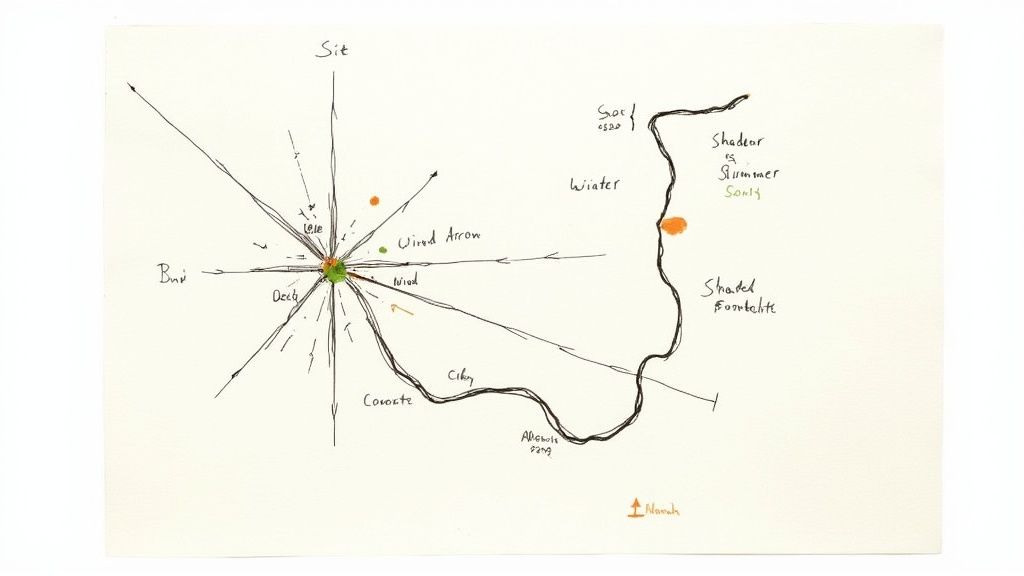
A truly great garden isn't about fighting nature; it's a partnership. Before you even think about which plants to buy, you need to become an expert on your own patch of land. This means getting out there to observe, analyse, and really understand the unique conditions you’re working with.
Think of your property as having its own personality. The way the sun travels across your section, the feel of the soil under your feet, and the direction the wind blows all play a huge role in what will thrive. Taking time to get this right from the start will save you countless hours of work and the heartache of watching beautiful plants struggle.
Understanding Your Soil's Personality
The absolute foundation of your garden is its soil. Here in New Zealand, that could be anything from heavy, water-retentive clay to free-draining sandy soil near the coast. Getting to know your soil type isn't just a suggestion—it's non-negotiable. It dictates everything.
You don't need a fancy lab kit to get started. Just grab a handful of moist soil (not dripping wet) and give it a squeeze.
- Does it form a sticky, solid ball that holds its shape? You're probably looking at clay soil. It’s rich in nutrients but can get waterlogged in winter and bake solid in summer. Digging in compost and gypsum will do wonders to break it up.
- Does it feel gritty and fall apart as soon as you open your hand? That's likely sandy soil. It drains fast, which means nutrients can wash away easily. Adding lots of organic matter like compost is key to helping it hold onto moisture and goodness.
- Does it hold its shape but crumble when you poke it? Congratulations, you've hit the jackpot with loam soil! It’s the perfect balance of sand, silt, and clay.
Mapping the Sun and Shade
The sun's path across your garden is one of the most critical things to map out. A spot that’s drenched in sun on a summer morning might be in deep shade by the afternoon. And, of course, the low angle of the winter sun changes everything completely.
Spend a day—or even just a few key moments in the morning, at midday, and in the afternoon—sketching a simple map of your property. Mark down which areas get full sun, which are in partial shade, and which corners stay cool and shady all day. Don’t forget to think about how this changes with the seasons; those long winter shadows can be a real surprise.
By understanding the light, you can place plants exactly where they want to be. Sun-worshippers like lavender and succulents can bake in the hottest spots, while ferns and hostas will thrive in those cool, shady corners. This simple act of observation is the key to a resilient garden.
New Zealand's Unique Challenges
Gardening in Aotearoa comes with its own set of environmental quirks. If you ignore them, you're signing up for a high-maintenance, struggling garden. The trick is to work with these conditions, not against them.
Here are a few common Kiwi challenges to consider:
- Persistent Winds: Anyone in Wellington or along the coast knows this one! Wind can dry out soil and batter delicate plants. Planting a tough shelterbelt of native shrubs like griselinia or corokia can create a much calmer microclimate for everything else.
- Coastal Salt Spray: If you’re lucky enough to live by the sea, you'll need plants that can handle the salt-laden air. Pōhutukawa, harakeke (flax), and many coprosma species are brilliant, tough-as-nails choices.
- Microclimates: Even within a single suburb, every garden has its own microclimate. A north-facing slope will be far warmer and drier than a south-facing one just a few metres away.
This idea of connecting a home to its surrounding environment has deep roots here. The evolution of landscape design in New Zealand has often mirrored our architectural trends. In the 1930s, European modernism started to influence how buildings opened up to their gardens. After the war, the boom in suburbs was heavily shaped by the 'Garden City Cottage movement,' which put a real emphasis on green spaces.
By taking the time to truly understand your land, you’re part of this long tradition of creating thoughtful, beautiful spaces that feel right at home.
Applying Core Landscape Design Principles
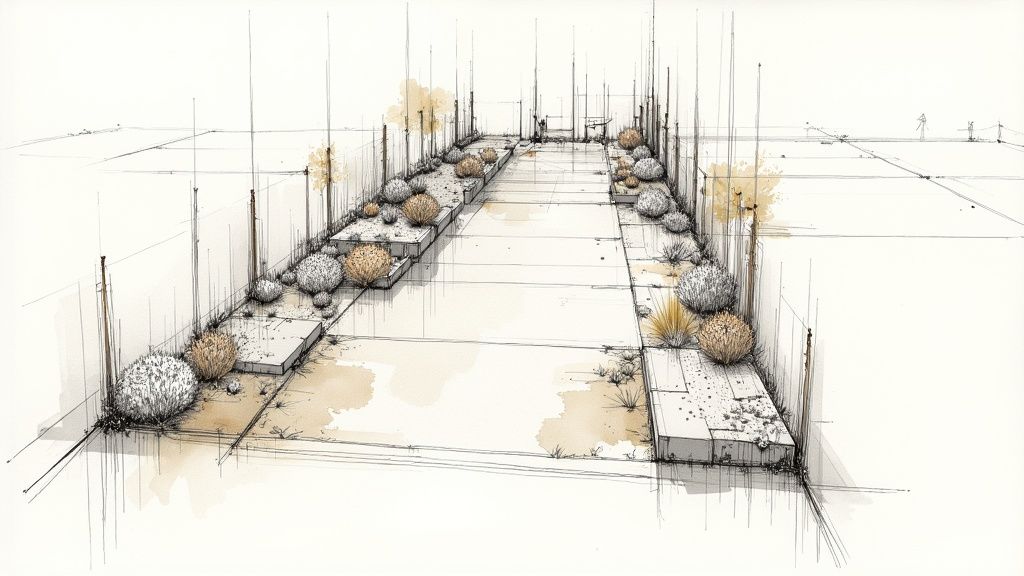
Alright, you’ve got a good feel for your site. Now comes the fun part—moving from analysis to artistry. This is where we start weaving all those ideas and observations into a garden that not only looks good but feels right.
We'll be using a few core principles that designers lean on to create spaces that feel intentional and balanced. Think of these less as rigid rules and more as friendly guides. They’re the secret to making sure your garden feels like a cohesive, harmonious whole, rather than just a random collection of plants.
Creating Unity Through Repetition
One of the easiest ways to bring a garden together is through unity, and the best tool for that is repetition. It’s all about creating a visual theme that runs through the entire space.
This doesn't mean you have to plant the same thing over and over. Instead, you could repeat a specific colour, texture, or plant form. For example, you might echo the deep burgundy of a Cotinus 'Grace' (smokebush) with some similarly toned heucheras or flaxes in another corner of the garden. Or maybe you repeat the fine, airy texture of a Chionochloa rubra (red tussock) with other ornamental grasses to create a soft, flowing feel.
It’s this simple act of repetition that creates rhythm and makes the whole landscape feel calm and organised. It’s the visual glue holding your design together.
Achieving Balance and Proportion
Balance is all about how you distribute the visual weight in your garden so no single area feels too heavy or too empty. You can tackle this in a couple of ways:
- Symmetrical Balance: This is your classic, formal look where one side of the garden is a mirror image of the other. Picture a central path with identical garden beds or rows of buxus hedging on either side. It creates a powerful sense of order.
- Asymmetrical Balance: This approach is far more relaxed and naturalistic, which often suits Kiwi gardens perfectly. Instead of a mirror image, you might balance a single large tree with a group of smaller shrubs and boulders on the other side. It feels more dynamic and less contrived.
Hand-in-hand with balance is proportion—making sure the size of everything feels right in relation to everything else. A tiny water feature will get completely lost next to a huge deck, and a massive sculpture could easily overwhelm a small courtyard. The goal is for every feature to feel like it belongs and is scaled correctly for the space it's in.
The Power of a Focal Point
Every great garden has a "wow" moment. It’s that one dominant feature that immediately grabs your attention and gives your eyes a place to land.
Here in New Zealand, a magnificent Pōhutukawa or a characterful, multi-trunked cabbage tree (Cordyline australis) makes a stunning natural focal point.
But it doesn't have to be a plant. Your focal point could be:
- A striking sculpture.
- A tranquil water feature.
- Even just a brightly painted front door or a beautifully designed seating nook.
The trick is to place it strategically. Use curving paths or clever planting to create sightlines that lead the eye right to it. This creates a sense of journey and discovery as you move through the garden.
A well-placed focal point does more than just add interest; it provides a visual starting point from which the rest of the garden's story can unfold. It gives your design purpose and direction.
Thinking about sustainability is also a key part of modern design. For instance, you can apply these same principles to create a garden that uses water wisely, which is where learning about drought tolerant landscape design can be incredibly useful. By thoughtfully blending unity, balance, and focus, you can transform your yard into something truly special.
Choosing Plants That Will Thrive
Here's where all that planning starts to pay off and your garden design really begins to take shape. It can be tempting to just wander through a garden centre and grab whatever catches your eye, but that’s a recipe for a garden that struggles.
The real secret to a stunning, low-fuss garden is putting the right plant in the right place. By choosing plants that are naturally suited to your property’s unique mix of sun, soil, and climate, you’re setting them up to flourish from day one. This simple philosophy is the bedrock of good landscape design and gardening—it means less work for you and healthier plants that will look fantastic for years.
Building Layers for Depth and Interest
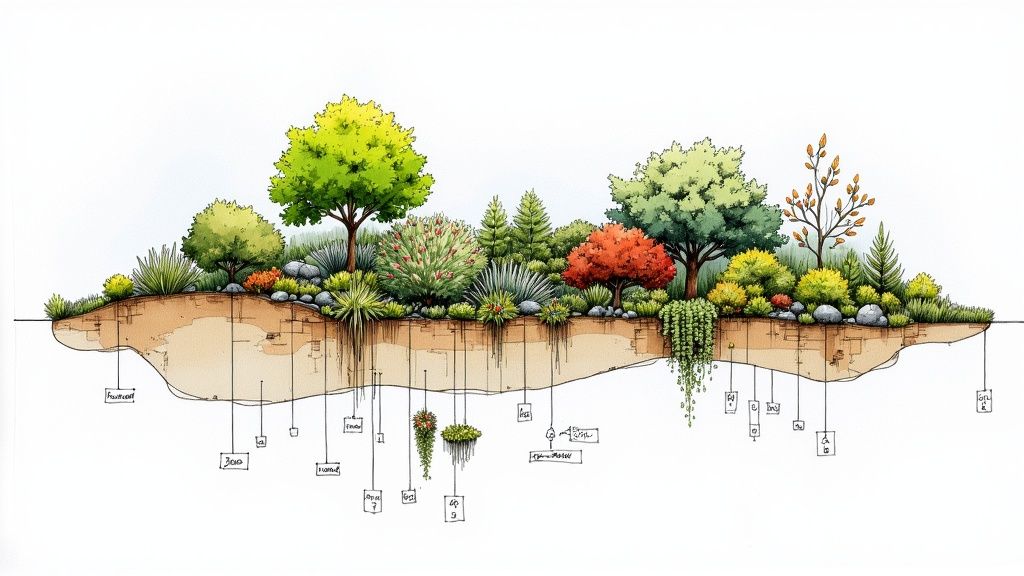
Think about a piece of bush track or a beautiful park; it’s never flat. Great gardens have the same sense of depth and structure, which you create by thinking in layers. It's about combining different heights, forms, and textures to build a scene that has interest all year round, not just when a few things are in flower.
Imagine your garden bed as a living composition made up of these parts:
- Canopy Layer: These are your tallest players—the trees that provide shade, privacy, and a vertical dimension. A native Kōwhai (Sophora microphylla), for example, gives beautiful structure and is a magnet for tūī.
- Shrub Layer: This is the garden's backbone. Evergreens like Griselinia or Corokia ‘Geenty’s Green’ offer year-round structure, while other shrubs can provide seasonal bursts of colour.
- Perennial and Grass Layer: Here's where you get to have fun with colour and movement. Perennials like salvias and libertia add seasonal pops, while ornamental grasses like Chionochloa rubra (red tussock) bring a wonderful softness and sway in the breeze.
- Groundcover Layer: Don't neglect the garden floor! Low-growers like Acaena inermis 'Purpurea' or native violets are brilliant for suppressing weeds, keeping moisture in the soil, and tying the whole look together.
When you thoughtfully combine these layers, you create a rich, dynamic space that’s far more engaging and resilient than a simple, one-dimensional flower bed.
Natives Versus Exotics: Getting the Best of Both Worlds
One of the best things about gardening in New Zealand is our climate. It allows us to grow an incredible range of plants from all over the globe, giving us a massive palette to play with. But the smartest approach is to build the foundation of your garden with plants that are proven to do well here.
Native plants are the perfect starting point. They're already adapted to our local conditions, which means they usually need less watering and general fussing once they're established. Even better, they support our local wildlife by providing food and habitat for birds and insects. If you’re keen on this, exploring a guide to creating a beautiful NZ native garden is a great next move.
That’s not to say you should avoid exotics entirely. Far from it! Many plants from similar climates—think the Mediterranean, parts of Australia, or South Africa—thrive here. The trick is to choose well-behaved species that won't become invasive weeds. A classic rose, a hardy Grevillea, or a sculptural Japanese maple can add that perfect touch of drama or contrast against a native backdrop.
The most successful Kiwi gardens often strike a beautiful balance. They use a strong framework of reliable natives and then artfully weave in select exotics for specific effects, whether it's for stunning flowers, unique foliage, or a beautiful scent.
This passion for creating beautiful outdoor spaces fuels a healthy local industry. The landscaping services sector in New Zealand has seen a compound annual growth rate of 1.0% between 2020 and 2025, driven by Kiwis investing in garden planting and creating outdoor living areas.
A Checklist for Smart Plant Selection
So, before you even think about heading to the nursery, get your criteria sorted. This will keep you focused and help you resist those impulse buys that just aren't right for your garden.
Your Plant-Buying Checklist:
| Consideration | Why It Matters |
|---|---|
| Ultimate Size | That cute little shrub could turn into a giant that swallows your path. Always check the plant label for its final height and spread. |
| Sun/Shade Needs | Does it need full sun, partial shade, or is it happy in the gloom? Match this to the sun map you made of your garden. |
| Water Requirements | Grouping thirsty plants together and drought-tolerant plants together makes watering so much more efficient and effective. |
| Soil Preference | While you can improve your soil, choosing plants that naturally like your clay or sandy conditions gives them a massive head start. |
| Hardiness | A plant that loves the Auckland heat might get completely scorched by a good frost in Christchurch. Know your local conditions. |
Thinking through these points elevates you from simply collecting plants to actually designing a garden—curating a selection of plants that are destined to thrive in your unique corner of Aotearoa.
From Plan to Reality: A Practical Guide
You’ve got the design finalised and your plant list is ready to go. Now for the exciting part: rolling up your sleeves and bringing that vision to life. This is where your garden plan leaps off the page and onto the soil, turning ideas into real garden beds, pathways, and beautiful new plantings.
It's tempting to jump straight in, but a successful garden is built on thorough preparation. Rushing this stage is a classic mistake that often leads to headaches down the track. Taking your time now gives your garden the best possible start and creates a solid foundation for everything that follows.
Preparing Your Canvas
Before a single plant goes in the ground, you need a clean slate. First things first, clear the entire area of any existing lawn, weeds, or debris. If you’re dealing with stubborn perennial weeds like couch grass or convolvulus, be ruthless and get as much of the root system out as you can—otherwise, they’ll be back.
With the area cleared, it’s all about the soil. As any experienced gardener will tell you, healthy soil is the secret to a thriving garden. Get your hands on some good-quality compost, aged manure, or other organic matter and spread a generous layer over the entire space. Dig it through to improve the soil's structure and drainage, while giving your new plants a nutrient boost.
Now you can mark out the shapes of your garden beds and paths. A garden hose, a bit of rope, or some landscape paint works perfectly. This simple step helps you visualise the layout in 3D, letting you tweak any curves or angles before you start digging.
Building the Bones: Hardscaping
Hardscaping covers all the non-living elements of your design—things like patios, paths, decks, and retaining walls. Think of these as the ‘bones’ of your garden; they provide structure and define the different spaces. It’s almost always best to get these built before you start planting to avoid trampling your new greenery.
Simple projects like installing garden edging or laying a small gravel path can be a really satisfying DIY job. However, for bigger, more complex structures like a retaining wall over a metre high or a large paved area, it’s often smart to call in a professional. A poorly built hardscape can be a costly and frustrating problem to fix later.
Interestingly, landscape architecture only became a formal profession here in New Zealand back in the early 1970s. Before that, it was mostly the domain of gardeners and nursery workers. This shift recognised the complex skill set needed for successful large-scale design and construction.
The Art of Planting
With the hardscaping in and your garden beds prepped, it's finally time for the plants. This is the magic moment your landscape design and gardening plan truly comes alive.
A plant's success is determined in the first few hours it's in the ground. Proper planting technique reduces transplant shock and helps roots establish quickly, setting the stage for a healthy, vigorous life.
For every plant you put in, follow these simple but crucial steps:
- Dig the Right Hole: Your hole should be about twice as wide as the plant's root ball, but no deeper. The top of the root ball needs to sit level with, or even slightly above, the surrounding soil.
- Tease the Roots: If the roots are tightly bound or circling at the bottom, gently loosen them up. This encourages them to spread out into their new home.
- Position and Backfill: Place the plant in the centre of the hole, making sure it’s standing straight. Backfill with the soil you dug out, gently firming it down to get rid of any air pockets.
- Water In Well: Don't skip this! Give the plant a deep, slow watering right away. This settles the soil and gives the roots the moisture they need to get started.
When you're thinking about your watering strategy, it's worth considering sustainable options. Using a 600 litre rainwater gardening IBC tote can be a brilliant way to manage water efficiently.
And if your plan includes a productive veggie patch, using purpose-built structures can give you a massive head start. If that sounds like you, check out our detailed guide on the benefits and setup of raised wooden garden beds.
Common NZ Gardening Questions Answered
Getting stuck into a new landscape design or gardening project always throws up a few questions. From figuring out when to actually start digging to deciding if you need to call in the pros, getting good advice upfront can make the whole journey a lot more fun.
Let's dive into some of the most common queries we hear from Kiwi gardeners, with a bit of practical advice to get you moving forward.
When Is the Best Time to Start a Landscaping Project in NZ?
Timing is huge in the garden, especially for the big stuff. While you could technically kick things off any time of year, autumn is hands-down the prime season for major landscaping work in New Zealand.
Why? The conditions are pretty much perfect. The soil is still warm from summer, which is exactly what new plants need to get their roots growing strong. At the same time, the air is getting cooler, which means way less stress on anything you're transplanting.
Autumn usually brings more reliable rain (in most parts of the country, anyway), so you'll spend less time dragging the hose around to help new plants settle in. It's also a great window for hardscaping jobs like laying patios or building paths, since the weather is often a bit more settled than the chaos of winter or spring.
By starting in autumn, you're giving your plants all of winter and early spring to build a really solid root system. It's the ultimate head start, getting them ready to absolutely take off when the warmer weather rolls back around.
How Can I Create a Low-Maintenance Garden in New Zealand?
The dream, right? A beautiful garden that doesn't eat up every single weekend. The good news is, a low-maintenance garden is totally achievable with some smart thinking in the design phase and even smarter plant choices.
The real secret is to work with our unique Kiwi environment, not against it.
- Go hard on natives. This is the number one rule. Plants that are native to your specific area are already built for the local climate and soil. Once they're established, they need far less water, food, and general fussing than most exotic plants.
- Mulch is your best mate. A thick layer of organic mulch, like bark chips or pea straw, does so much good. It keeps weeds down, holds moisture in the soil through our dry summers, and slowly breaks down to feed the earth.
- Pick slow-growers. Those fast-growing hedges look great at first, but they quickly turn into a never-ending pruning job. Choosing slower-growing varieties means you'll spend a lot less time with the secateurs in your hand.
- Group plants with similar needs. It sounds simple, but putting plants that like the same amount of sun and water together makes your life so much easier. This "zoning" means you’re not trying to keep a thirsty plant happy right next to one that prefers to be dry.
- Rethink your lawn. A massive lawn means a massive commitment to mowing, feeding, and watering. Think about shrinking it down in favour of more garden beds, a paved area, or even a gravel courtyard to slash your maintenance time.
Should I Hire a Professional Landscape Designer?
This is a classic dilemma, and the honest answer depends on the size of your project, your budget, and how confident you feel. There's no right or wrong answer, but here's how to think it through.
Going the DIY route can be incredibly satisfying for smaller, more straightforward garden makeovers. If you have a clear vision and love getting your hands dirty, it’s a brilliant way to learn and really connect with your space.
But for bigger sites or properties with real challenges, a professional landscape designer brings a level of expertise that can be a lifesaver. If you're dealing with steep slopes, serious drainage problems, or need to get your head around council consents, their knowledge can help you dodge some very costly mistakes. They see the big picture and create a cohesive plan that pulls everything together properly.
A great middle-ground? Hire a designer to draw up the master plan, then you can tackle the work yourself in stages as your time and budget allow. You get the benefit of their professional eye, but you still get to do the fun stuff.
What Are Some Common Mistakes to Avoid in NZ Gardens?
Learning from what not to do is one of the fastest ways to get good at this.
A classic mistake is underestimating the sheer intensity of the New Zealand sun and the power of our relentless wind. Plonking delicate plants in a spot that gets baked all afternoon with no protection is a surefire way to create a stressed-out, sad-looking garden. Always, always pick plants suited to your specific microclimate.
Another one we see all the time is planting everything too close together. It's easy to do when all your plants are tiny, but you have to plan for how big they'll get. Overcrowding leads to poor airflow (which pests and diseases love) and creates a battle for light, water, and nutrients.
And maybe the biggest mistake of all is skipping proper soil prep. It’s not the most glamorous part of gardening, but working heaps of good-quality organic compost into your soil before you plant a single thing is the single best investment you can make for the long-term health of your garden.
At Jungle Story, we're all about helping Kiwis create outdoor spaces they absolutely love. From tough-as-nails native shrubs to stunning feature plants, find everything you need to bring your garden vision to life on our comprehensive online marketplace. Explore our collection at https://junglestory.co.nz.