
There's nothing quite like the taste of a sun-warmed fig, picked straight from your own tree. If you're a Kiwi gardener dreaming of this, you're in luck. Some of the best fig varieties in NZ are incredibly reliable growers, like the classic Brown Turkey, the rich Brunoro Black, or the super sweet Mrs Williams. This guide is all about making that dream a reality in your own backyard.
Your Guide to Growing Figs in New Zealand
Growing figs here in New Zealand is a surprisingly rewarding project, and it's far easier than you might think. Let's bust the myth that figs are fussy or only belong in a Mediterranean climate. The truth is, our temperate conditions—from the balmy north right down to the cooler south—can support a fantastic range of delicious fig varieties.
All it takes is a little know-how to enjoy a bumper crop of this ancient, luscious fruit. The secret really comes down to picking the right type for your garden and climate, and that's exactly what we'll demystify here.
Why Grow Figs in Your Kiwi Garden
Figs are one of those special plants that deliver on both looks and taste. Their big, striking leaves add a lush, almost tropical vibe to any garden space, while the fruit is a true gourmet treat.
A single, well-cared-for fig tree can produce fruit for decades, becoming a cherished and productive feature of your property. It’s an investment in both your garden’s beauty and your pantry’s contents.
Beyond their incredible flavour, having your own fig tree comes with some real perks:
- Freshness and Taste: Figs you buy in the store are often picked under-ripe so they can survive the journey. A homegrown fig, left to ripen to perfection on the branch, is a completely different (and far superior) taste experience.
- Adaptability: So many fig varieties are wonderfully versatile. You can let one grow into a magnificent feature tree, train it flat against a sunny wall (espalier), or even keep it compact in a large pot on the deck.
- Low Maintenance: Once they're settled in, fig trees are remarkably tough and don't demand much fuss compared to other fruit trees. They handle dry spells well and aren't as prone to the usual pests and diseases.
This article will walk you through everything you need to know, from choosing the perfect tree to the simple care that leads to sweet success. For a wider look at productive plants, check out our guide to the best fruit trees for NZ gardens.
Why Common Figs Are Perfect for NZ Gardens
Before you start dreaming of all the delicious fig varieties available in New Zealand, there's one crucial thing you need to know to guarantee a bountiful harvest. Not all figs are created equal, and for us Kiwi gardeners, the choice is actually wonderfully simple: you need to plant a 'common fig'.
These incredible trees have a superpower called parthenocarpy. It sounds very scientific, but all it really means is they can produce fruit without any pollination. Think of it this way: most fig trees around the world need a tiny, highly specialised insect called a fig wasp to act as a key, unlocking their ability to fruit. The catch? That specific wasp doesn't live here in New Zealand.
Common figs, luckily for us, don't need that key. They're completely self-sufficient and will happily give you bucketloads of luscious fruit all on their own. This makes them the only reliable choice for our gardens.
The Magic of Two Harvests: Breba and Main Crops
As if that wasn't enough, many common fig varieties reward you with two separate harvests in a single year, a fantastic bonus perfectly suited to our Southern Hemisphere seasons.
- The Breba Crop: This is your early-summer treat. These figs form on last year's mature wood. They start developing in autumn, take a nap over our winter (June - August), and then race to ripen as things warm up in late spring.
- The Main Crop: This is the big one. It's the primary harvest that grows on the current season's new, green shoots. These figs appear in spring and ripen gradually from late summer right through autumn, usually from February to May.
Having a tree that gives you both a breba and a main crop is a game-changer. It stretches out your fresh fig season, letting you enjoy homegrown fruit at two distinct times of the year.
The Not-So-Secret Ingredient: Sunlight
To fuel all this amazing fruit production, your fig tree needs one thing above all else: sun. Lots of it.
While it's hard to pin down the exact number of fig varieties grown across the country, they are a firm favourite for a reason. New Zealand's climate is ideal for them, provided they get at least 6 to 8 hours of direct sunlight every day. This is non-negotiable for good growth and a heavy crop. For a deeper dive, there's a great guide on sunlight requirements for fig trees you can check out.
By picking a self-fertile common fig and planting it in the sunniest spot you can find, you're setting yourself up for decades of delicious fruit. With that sorted, you're now ready to explore the specific varieties that will shine in your garden.
Right, let's get into the exciting part – picking the perfect fig to plant in your garden. With so many fantastic options out there, it can feel a bit daunting trying to choose just one. To make it easier, I’ve pulled together a list of some of the most popular and reliable fig varieties in NZ. Each one has its own personality, flavour, and way of growing.
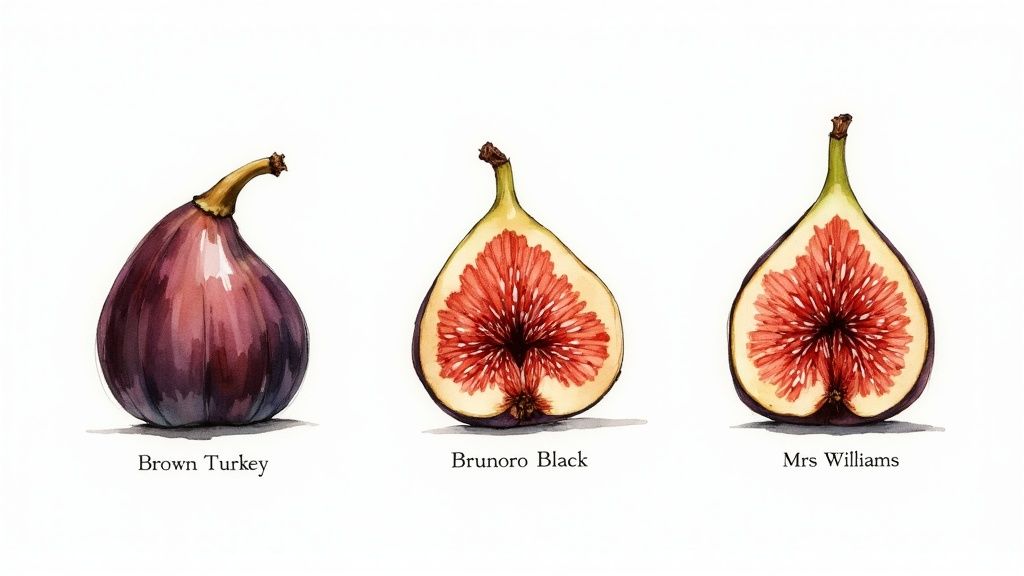
Many of these figs have been Kiwi garden staples for generations. The history of bringing new plants to our shores is a long one, with nursery catalogues documenting arrivals as far back as 1861. These old records give us a fascinating peek into how today's garden favourites, figs included, first put down roots in New Zealand. If you're a bit of a history buff, you can read the research on plant introduction through nursery catalogues to see how it all unfolded.
Now, let’s look at some top choices for your backyard.
Brown Turkey: The All-Rounder
If you're after a dependable, no-fuss fig that just gets on with the job, 'Brown Turkey' is the undisputed champion. It’s a brilliant starting point for anyone new to growing figs because it’s incredibly tough and handles a wide range of climates across the country, from sunny Northland right down to Canterbury.
The fruit itself is medium-sized with brownish-purple skin and sweet, mild amber flesh. What makes 'Brown Turkey' such a Kiwi favourite is its sheer reliability. It consistently gives a decent 'breba' crop (that's the first, early-summer crop) and follows it up with an abundant main crop from late summer into autumn. It has a vigorous, spreading habit, but don't worry – it takes well to a good prune to keep it in check.
Brunoro Black: The Flavour King
For those who are all about taste, 'Brunoro Black' (sometimes sold as 'Black Brunswick') is an absolute must. This variety produces small-to-medium figs with stunning, dark purple-black skin. Inside, you'll find rich, jammy, dark red flesh that delivers an intensely sweet and complex flavour.
'Brunoro Black' is a great pick for cooler regions, as it ripens its main crop without any trouble. It tends to put all its energy into one spectacular autumn harvest rather than producing a big breba crop. The tree itself is moderately vigorous, making it easy to maintain in a smaller garden or even in a large pot.
Mrs Williams: The Sweet Giant
Do you dream of picking huge, lusciously sweet figs? Then 'Mrs Williams' is the one for you. This heritage variety produces seriously large fruit with greenish-yellow skin that often gets a lovely pink blush when it's perfectly ripe. The flesh is a beautiful strawberry pink, with a syrupy, honey-sweet flavour.
This one's a strong, vigorous grower, so it needs a bit more room to stretch its legs. 'Mrs Williams' is a star performer in the warmer parts of New Zealand, reliably giving you both a decent breba crop and a heavy main crop. That means you get a nice long harvest season.
Vlasoff: The Compact Performer
Perfect for smaller backyards or growing in a container, 'Vlasoff' is a more compact tree that still packs a punch when it comes to fruit. It yields medium-sized, roundish figs with eye-catching green and purple striped skin.
The flesh is a deep, rich red with a superb, sweet flavour that’s just perfect for eating straight off the tree. 'Vlasoff' is particularly well-suited to the New Zealand climate, doing well in both warmer and slightly cooler areas. It produces its main crop in late summer and is a fantastic choice if you want big flavour without needing a big space.
French Sugar: The Preserving Favourite
Also known as 'Goutte d'Or' (which means Drop of Gold), 'French Sugar' is famous for its massive yields and incredibly sweet, honey-like flavour. The figs are medium-sized with yellowish-green skin and pale, amber-coloured flesh that’s almost see-through when it’s ripe.
Because of its high sugar content and rich, syrupy texture, 'French Sugar' is an exceptional choice for making jams, pastes, and other preserves. It also dries beautifully, allowing you to enjoy your harvest long after the season ends.
This variety is also quite cold-hardy. It produces a very generous breba crop followed by a solid main crop, making it a reliable and versatile workhorse for any Kiwi garden.
Fig Variety Comparison for NZ Gardeners
To help you see everything at a glance, here's a quick-reference table comparing the key features of these popular fig varieties.
| Variety Name | Best For | Fruit Flavour and Colour | Harvest Time (NZ) | Growth Habit |
|---|---|---|---|---|
| Brown Turkey | Beginners, all-round reliability | Mildly sweet, amber flesh; brownish-purple skin | Breba: Early Summer, Main: Late Summer-Autumn | Vigorous and spreading |
| Brunoro Black | Flavour enthusiasts, cooler climates | Intensely sweet, jammy, dark red flesh; black skin | Main: Autumn | Moderately vigorous |
| Mrs Williams | Large fruit, warmer climates | Honey-sweet, strawberry-pink flesh; greenish skin | Breba: Early Summer, Main: Late Summer-Autumn | Strong and vigorous |
| Vlasoff | Small spaces, container growing | Superb sweet flavour, deep red flesh; striped skin | Main: Late Summer | Compact |
| French Sugar | Preserving, jams, drying, high yields | Very sweet, honey-like, amber flesh; yellow-green skin | Breba: Early Summer, Main: Late Summer-Autumn | Vigorous, cold-hardy |
Hopefully, this table makes it a bit easier to weigh up your options and find the fig that’s just right for your garden and your tastebuds.
How to Choose the Right Fig Tree for Your Garden
Getting this choice right from the start is your ticket to decades of incredible, sun-warmed fruit. With so many tempting fig varieties in NZ, it’s easy to get carried away by flavour descriptions alone. But it really pays to think about how a tree will actually fit into your garden and your life.
A little bit of planning now saves a lot of hassle later and ensures your new fig tree will be happy. The trick is to match the tree's personality to your specific spot. It just means taking an honest look at your climate, how much room you have, and what you dream of doing with all those delicious figs.
Assess Your Climate and Space
First things first, what’s your local climate like? Figs are pretty adaptable, but some definitely handle the cooler southern winters better than others. If you're gardening south of the Bombay Hills and deal with regular frosts, look for proven performers like ‘Brown Turkey’ or ‘French Sugar’. They're known for their cold hardiness.
Next, get out the measuring tape. How much space do you really have? A vigorous variety like ‘Mrs Williams’ needs plenty of room to stretch out on a lifestyle block. On the other hand, a compact grower like ‘Vlasoff’ can live quite happily in a large pot on a sunny deck. Don't underestimate how big these trees can get! It's often much easier to choose a naturally smaller type than to be constantly fighting to keep a giant one in check.
For more ideas on getting the most out of a smaller area, check out our guide to the best trees for small gardens in NZ.
Define Your Fig's Purpose
What are your fig-related dreams? Knowing how you plan to use the fruit is a massive help in narrowing down your choices.
- For Fresh Eating: If you want to pluck them straight from the branch, look for varieties praised for a rich, complex flavour and soft, luscious texture. The intensely sweet ‘Brunoro Black’ is a perfect example.
- For Preserving and Jam: You’ll want varieties with a really high sugar content. Something like ‘French Sugar’ is ideal, as its syrupy flesh cooks down into a beautiful, flavour-packed preserve.
- For Drying: Denser, less juicy figs are your best bet here. They hold their shape and concentrate their sweetness perfectly without making a mess.
Choosing a fig is a bit like choosing a pet; it's about finding the right personality to fit your home. A sprawling tree in a tiny courtyard will be as unhappy as a large dog in a small apartment.
Tips for Buying a Healthy Tree
When you’re finally at the nursery, ready to pick your tree, give the plant a quick health check. You're looking for a strong, straight main stem and healthy, vibrant green leaves. Steer clear of anything with yellowing leaves, spots, or damaged bark.
Basically, avoid trees that look spindly or show any signs of pests. A healthy start is the best guarantee of a long and very fruitful life for your new fig tree.
Planting and Caring for Your Fig Tree

So you’ve picked out the perfect fig variety for your Kiwi garden. Fantastic! Now comes the fun part: giving it a great start in its new home. Getting the planting and early care right sets the stage for a tree that’ll be dishing out delicious fruit for years, even decades, to come.
The good news is that figs are remarkably forgiving once they’ve settled in. Your main jobs are to give them plenty of sun, good drainage, and a bit of support as they find their feet in the first couple of years.
Finding the Perfect Spot and Planting Time
A happy fig tree really boils down to two things: maximum sun and excellent drainage. They are absolute sun-worshippers, needing at least 6-8 hours of direct sunlight every day to produce those sweet, jammy fruits we all crave. A north-facing wall is often the ideal spot, as it soaks up the sun and radiates extra warmth back onto the tree.
Here in New Zealand, the best times to plant are either autumn (April-May) while the soil is still warm, or in early spring (late August-September) once the danger of heavy frosts has passed. Planting in these windows gives the roots a chance to get established before the stress of summer heat or winter chill kicks in.
When you’re ready to plant, make sure the hole is twice as wide as the root ball, but no deeper. Gently loosen up any roots that are circling the pot and backfill with a mix of your garden soil and some good quality compost. Give it a deep watering to settle everything in and get rid of any air pockets.
A well-planted fig tree is an investment in your garden's future. The care you take on day one directly translates into the health and productivity you'll enjoy for the next 20, 30, or even 50 years.
Watering and Feeding for a Bountiful Harvest
For the first summer, young fig trees need consistent moisture to get established. A deep watering once or twice a week during our classic hot, dry spells should do the trick. Once they’re mature, figs are surprisingly drought-tolerant, but you'll get much larger, juicier figs if you give them a good soak while the fruit is developing.
Feeding is pretty straightforward. A dose of balanced, slow-release fertiliser in early spring just as new growth starts is usually all they need. I also like to give them a light top-dressing of well-rotted compost or sheep pellets around the base to provide extra nutrients.
The enthusiasm for growing unique edibles like figs is part of a wider movement towards sustainable gardening in our country. It's fascinating to see how even common plants like Ficus carica fit into our local ecosystem. If you're curious, the New Zealand Plant Conservation Network has some great information on its presence here.
Simple Pruning for Health and Shape
Pruning is a winter job, best done in late winter (July-August) when the tree is dormant. The main goal is to create an open, vase-like shape. This lets sunlight and air get to all parts of the tree, which is crucial for ripening fruit and keeping diseases at bay.
Just follow these simple steps each year:
- Start by removing any dead, damaged, or diseased wood. This is your number one priority for a healthy tree.
- Cut back any branches that are crossing or rubbing against each other. This prevents wounds that can invite problems later.
- Thin out the centre of the tree to let the light in. You're aiming for a strong framework of three to five main branches.
If you're growing your fig in a container, pruning is also key to keeping it a manageable size. For more tips on container gardening, check out our guide on the best plants for outdoor pots in NZ.
Got Questions About Growing Figs? We’ve Got Answers
Even with the best intentions, a few questions always pop up when you’re getting to know a new plant. Growing figs in New Zealand is surprisingly simple, but it’s completely normal to wonder about the details.
We’ve pulled together the most common queries from Kiwi gardeners to help you get started with total confidence. Let’s clear up the confusion so you can get on with the fun part – watching your tree thrive!
Do I Need Two Fig Trees to Get Fruit?
This is easily the question we hear most often, and the answer is a big, happy no. You only need one tree to get a fantastic harvest.
The common fig varieties available in NZ are all ‘self-fertile’. In simple terms, this means they don’t need a second tree for pollination to produce fruit. It’s one of the key reasons they do so well here, as we don't have the specific fig wasp that other types of figs found overseas rely on.
When’s the Best Time to Prune My Fig Tree in New Zealand?
Getting your timing right with pruning makes all the difference. The sweet spot for pruning your fig tree in New Zealand is during its winter dormancy, usually around July or early August.
Pruning while the tree is ‘asleep’ encourages a burst of healthy new growth in spring, and that’s exactly where your main crop of figs will appear.
Your goal should be to create an open, vase-like shape. Snip off any dead, damaged, or crossing branches. This lets air and sunlight get right into the centre of the tree, which is vital for ripening up that delicious fruit.
Can I Actually Grow a Fig Tree in a Pot?
You absolutely can! Figs take beautifully to container growing, making them a brilliant choice for smaller gardens, patios, or even a sunny balcony. Their roots don’t mind being a little contained; in fact, it can sometimes encourage them to start fruiting even sooner.
For the best shot at success, just keep these tips in mind:
- Go for a Big Pot: Choose a container that’s at least 50-60cm wide. This gives the roots enough room to establish themselves.
- Drainage is Everything: Make sure your pot has plenty of drainage holes. Figs hate having "wet feet" and can quickly suffer from waterlogged soil.
- Water and Feed More Often: Potted plants dry out much faster and can't search for nutrients like garden trees can. They'll need more regular watering and a good feed, especially during our hot Kiwi summers.
How Do I Know When My Figs Are Ready to Pick?
This is the moment you’ve been waiting for! Knowing when to harvest is key to getting that perfect, honey-sweet flavour. Unlike a lot of other fruit, figs stop ripening the second you pick them, so timing is critical.
Look out for these three tell-tale signs:
- Colour: The fig will have changed to its full, rich colour, depending on the variety.
- Feel: It should feel soft and give a little when you gently squeeze it. An unripe fig will be hard and firm.
- Droop: The fruit’s stem (or ‘neck’) will often soften, causing the fig to droop downwards on the branch instead of pointing outwards.
When you see all three signs, your fig is at its peak. It's ready to be picked and enjoyed, preferably while it’s still warm from the sun.
At Jungle Story, we connect you with trusted local growers offering a stunning selection of fig varieties perfect for your Kiwi garden. Find your ideal tree and start your journey to homegrown fruit today at https://junglestory.co.nz.
1 則留言
Great summary of growing figs in NZ! Thank you!