
If you're a Kiwi gardener keen to turn a bare patch of land into a lush, green space, you've probably wondered which trees will get you there the fastest. The good news is you have some fantastic options, from native powerhouses like the mighty Ribbonwood to iconic exotics like the Tulip Tree, which puts on a spectacular seasonal show.
Choosing the right tree means you can get the results you're after—whether that's a bit of privacy from the neighbours, a solid shelterbelt, or a stunning feature tree—in record time.
Your Guide to Fast Growing Trees in NZ
We all know patience is a virtue, but let's be honest, waiting a decade for a tree to mature can feel like a lifetime in gardening years. Many of us want to enjoy the benefits of a well-grown tree—shade on a hot day, a bit of privacy, or simply something beautiful to look at—without the long wait. This is where a bit of savvy plant selection comes in.
But what does "fast-growing" really mean here in New Zealand? It’s not just about a tree shooting skywards overnight. A truly great fast-growing tree is one that gets its roots down quickly, is tough enough for our changeable conditions, and starts doing its job within just a few years. A hedge tree needs to get dense and bushy fast, while a shade tree needs to start developing a decent canopy.
Understanding Growth Rates
The word "fast" can mean different things for different trees. Some species can easily put on over a metre a year, while for others, a respectable 50-60cm is considered speedy. A tree's growth is also massively influenced by its location. The soil, amount of sun, and local climate—from the balmy north to the cooler, drier south—all play a huge part.
To help you narrow down your choices, think about what you need the tree for. This usually falls into one of three camps:
- For Instant Privacy: You’ll want trees that produce thick, dense foliage quickly. These are perfect for creating a living wall that blocks out prying eyes and muffles noise.
- For Effective Shelter: These are the tough guys. They're chosen for their ability to form a strong windbreak, protecting your garden, home, and outdoor living areas from those classic Kiwi gales.
- For a Striking Feature: This is your garden's showstopper. A fast-growing feature tree quickly becomes a focal point with its unique shape, gorgeous flowers, or dazzling autumn colours.
To give you a head start, we've put together a quick comparison of some of the best native and exotic options available for your garden project.
NZ's Top Fast Growing Trees at a Glance
This table offers a quick snapshot of some popular native and exotic fast-growing trees that thrive in New Zealand. It’s a great starting point for matching a tree's growth rate and strengths to your garden's needs.
| Tree Name | Category | Typical Annual Growth | Ideal For |
|---|---|---|---|
| Pittosporum eugenioides (Lemonwood) | Native | 50cm - 1m | Hedges, Screens, Fragrance |
| Plagianthus regius (Ribbonwood) | Native | 1m+ | Shelterbelts, Revegetation |
| Liriodendron tulipifera (Tulip Tree) | Exotic | 60cm+ | Feature Tree, Shade, Autumn Colour |
| Eucalyptus (various species) | Exotic | 1.5m+ | Firewood, Shelterbelts, Fast Cover |
| Cordyline australis (Cabbage Tree) | Native | 30 - 50cm | Architectural Feature, Hardy Planting |
Whether you're after the dense, scented foliage of a Lemonwood hedge or the rapid cover from a Eucalyptus, knowing the basics helps you pick the perfect tree for the job. Now, let's dive deeper into what makes each of these trees a fantastic choice.
How Trees Grow Fast in the New Zealand Climate
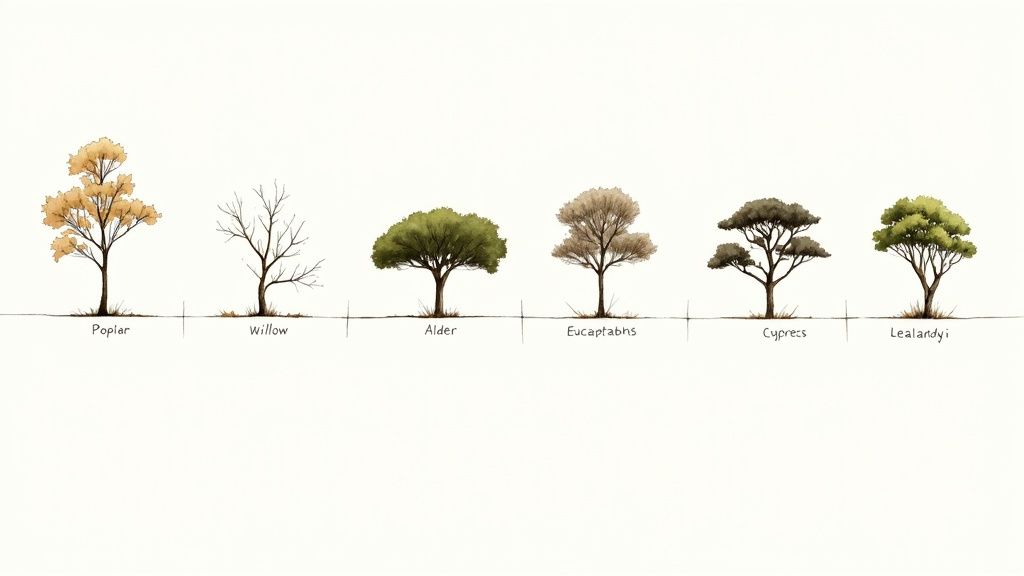
Ever wondered why a tree thrives in your neighbour's garden but seems to struggle in yours, even just a street away? It all comes down to the specific environment. Understanding the 'why' behind rapid growth is the key to successfully cultivating fast growing trees nz and turning a simple planting project into a real success story.
A tree’s growth rate isn’t just about what species it is; it’s a direct response to its surroundings. Think of it like baking a cake. You can have the best ingredients (a quality tree), but if the oven temperature is off (sunlight) or you forget a key ingredient (water), the result won't be what you hoped for. New Zealand's diverse regional climates provide a fascinating mix of these 'ingredients'.
The Role of Soil in Rapid Growth
The foundation of any fast-growing tree is, quite literally, the ground it stands on. New Zealand’s soils are incredibly varied, from the rich, free-draining volcanic soils of the Central Plateau to the heavy, moisture-retentive clays found in parts of Auckland and the South Island.
- Volcanic and Alluvial Soils: Often found in places like Taranaki and the Waikato, these soils are usually fertile and well-draining. This structure lets tree roots breathe and spread out easily, accessing nutrients without getting waterlogged—a perfect recipe for quick establishment.
- Clay Soils: Common in many regions, clay can be a double-edged sword. While it's often rich in nutrients, its dense structure can hold too much water in winter and bake hard as a rock in summer, making it tough for roots to grow. Improving clay with organic matter like compost is vital to unlock its potential for fast-growing species.
Choosing a tree that is naturally suited to your soil type gives it an immediate head start. Alternatively, amending your soil before you plant can create the ideal 'home' for your chosen tree to flourish from day one.
The single most important factor for getting a tree established quickly is providing the right soil conditions. A tree in perfect soil will often outperform a genetically 'faster' tree in poor soil.
Sunlight and Rainfall: The Fuel for Growth
Beyond the soil, two other environmental factors act as the main fuel for a tree’s growth engine: sunlight and water. Photosynthesis, the process that converts light into energy, is directly tied to the amount of sun a tree receives.
A tree planted in an open, north-facing spot will nearly always grow faster than the same tree planted in the shadow of a building or a larger tree. It’s simple—it's getting more energy to power its growth throughout the day.
Rainfall is the other critical piece of the puzzle. Consistent moisture, especially during the crucial first few years after planting, allows a tree to transport nutrients and maintain its cell structure. New Zealand’s rainfall patterns vary dramatically, from the wet West Coast to the drier eastern regions like Canterbury and Hawke's Bay.
This is why picking a tree adapted to your local rainfall is so important. A species that expects high rainfall will struggle and grow slowly in a dry climate without extra watering, while a drought-tolerant tree might be perfectly happy. For anyone looking for fast growing trees nz, matching the species to your local sun and water availability is completely non-negotiable.
Choosing Fast Growing Native New Zealand Trees
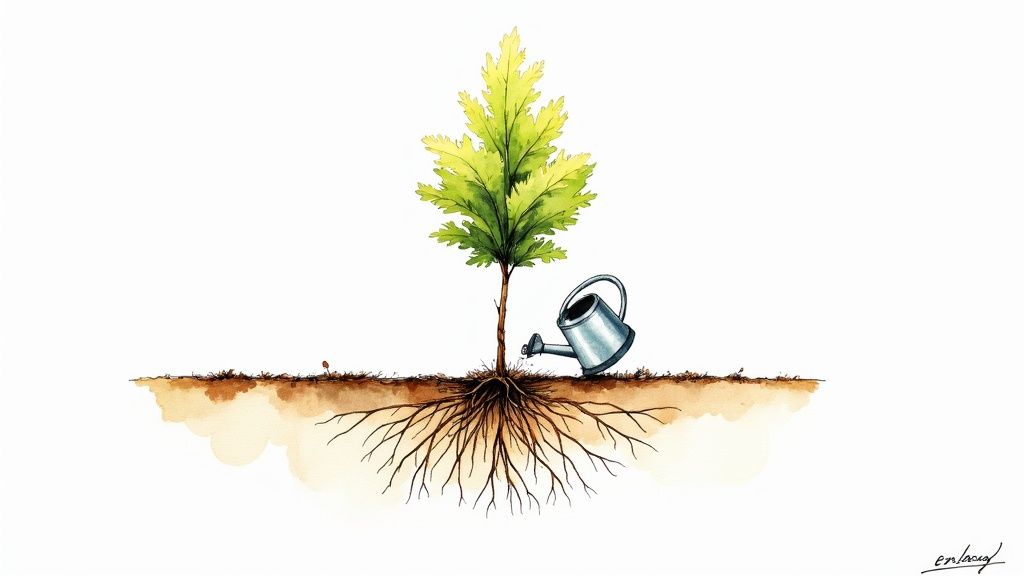
There’s something special about bringing Aotearoa’s natural heritage into your own backyard. It's more than just aesthetics; you're creating a living ecosystem that supports our local wildlife and is perfectly suited to our unique conditions. When you plant a native, you're not just adding a tree—you're weaving a piece of New Zealand's story into your property.
And the best part? You don’t have to wait a lifetime to see the impact.
Many of our native species are absolute champions when it comes to growth, getting established and making a statement in no time at all. Let's get to know the personalities behind some of these incredible fast growing trees nz has to offer, looking at what makes each one unique.
Pittosporum: The Ultimate Privacy Solution
When you need a fast, dense, and attractive screen, Pittosporum species are the undisputed superstars of the Kiwi garden. They're incredibly versatile, tough as old boots, and their dense foliage is tailor-made for privacy hedging.
Imagine you need to screen out a two-storey neighbour or block the view of a busy road. Instead of a stark fence, you could plant a row of Pittosporum tenuifolium (kōhūkōhū). Within a few years, you’ll have a lush, living wall that not only gives you privacy but also filters wind and dampens noise.
There are heaps of cultivated varieties to choose from, each with a different vibe:
- 'Stephens Island' is a classic choice, loved for its vibrant green leaves and its tolerance for salty coastal air.
- 'Silver Sheen' offers something a bit more delicate, with smaller, silvery leaves on dark stems that create a beautiful shimmering effect.
- 'Wrinkled Blue' brings a unique texture to the garden with its distinctive blue-green, wavy-edged foliage.
What's great about Pittosporum is that it builds a screen without the aggressive root systems you find in some exotic alternatives. That makes it a much safer pick for planting near paths and driveways. For more great screening ideas, check out our guide to https://junglestory.co.nz/blogs/plant-care/fast-growing-hedges-nz.
Ribbonwood (Mānatu): The Deciduous Speedster
If you need height, and you need it fast, look no further than Ribbonwood (Plagianthus regius). This remarkable native is one of Aotearoa’s few truly deciduous trees, and its growth rate is legendary among gardeners and restoration experts.
Think of Ribbonwood as the garden's gentle giant. In summer, its light, airy foliage creates a soft, dappled shade that's perfect for underplanting. Come autumn, it puts on a lovely show, its leaves turning a buttery yellow before they fall. This lets all that precious winter sunlight stream into your home and garden right when you need it most.
Because it grows so quickly, Ribbonwood is a fantastic 'nurse tree' for bigger revegetation projects. It shoots up to provide shelter, protecting slower-growing, long-lived species like Tōtara or Pūriri while they get established.
Ribbonwood is a top-notch candidate for shelterbelts on lifestyle blocks or as a tall, elegant feature tree in a larger suburban garden. It can quickly reach heights of 10 to 15 metres, making it a go-to for revegetation and ecological restoration.
Kōwhai: A Beacon for Native Birds
While it might not be the fastest in sheer vertical height, Kōwhai (Sophora species) is a champion for establishing ecological value in a hurry. Its growth is often more focused on creating a broad, graceful shape, and it doesn't take long at all before it starts producing its iconic, golden-yellow flowers.
Planting a Kōwhai is like installing a bird feeder that never runs out. Through late winter and early spring, its nectar-rich flowers are a critical food source for our native birds like the Tūī, Bellbird (Korimako), and Silvereye (Tauhou).
Here are a few ideas for placing a Kōwhai:
- Near a window, so you can watch the birds flock to its blossoms during the cooler months.
- As a feature tree in the middle of a lawn, where its beautiful weeping form can be fully admired.
- In a mixed native border, where it adds a brilliant splash of colour when little else is flowering.
Choosing a Kōwhai proves that a fast growing tree in nz is about more than just speed. It's about how quickly that tree starts doing its job in the garden—and for Kōwhai, that job is supporting our precious native fauna.
Of course. Here is the rewritten section, crafted to sound like it was written by an experienced human expert, following your specific style and formatting requirements.
Exotic & Timber Trees: A Different Kind of Growth
While our native trees are the ecological backbone of New Zealand, sometimes a garden needs a bit of drama. This is where fast-growing exotic and timber trees really shine. They can bring spectacular seasonal displays, unique architectural forms, or even the promise of a long-term timber harvest to your property.
When I talk about exotics, I’m talking about species brought into New Zealand that have absolutely thrived here. They often give us something our native flora can't, like the breathtaking autumn colours of a deciduous tree or the sheer growth speed of certain evergreens. You choose them for a specific look or function.
Timber trees, on the other hand, are planted with a different endgame in mind. It's all about the quality of the wood, its strength, and how reliably it grows. This group includes some of our own native giants as well as productive exotic species, all valued for what they'll become in the future.
Exotic Trees for Serious Visual Impact
Exotic trees are often planted to be the star of the show. They create a focal point that just commands your attention, whether through a blast of colour, a striking shape, or impressive size.
A fantastic example is the Tulip Tree (Liriodendron tulipifera). People adore it for its uniquely shaped leaves and stunning, tulip-like flowers that pop up in late spring. Come autumn, it puts on an incredible show, with its foliage turning a brilliant golden yellow. A Tulip Tree can shoot up by more than 60cm a year, quickly becoming a magnificent shade tree.
If you're after year-round structure, some evergreen exotics are simply unmatched. The Italian Cypress (Cupressus sempervirens), for example, adds a strong vertical line with its slender, pillar-like form, bringing a touch of Mediterranean class to a more formal garden.
How Timber Trees Grow Differently
When you’re choosing a tree for timber, the numbers you care about are a bit different. It’s not just about how tall it gets; it’s about how the trunk thickens. The key metric is the annual diameter increase, often called Diameter at Breast Height (DBH). This tells you how much girth the tree is putting on each year—absolutely vital for timber production.
Think of it this way: a fast-growing screening hedge is like unrolling a wide carpet—it gives you quick coverage. A timber tree is more like stacking bricks—it’s all about building solid, usable mass, one layer at a time.
It’s this steady accumulation of wood that makes timber trees such a worthwhile long-term project for lifestyle blocks and larger properties.
A key thing to remember with any timber planting is that you're playing the long game. The growth might seem slow year by year, but what you end up with after a few decades can be a sustainable source of high-quality wood, creating a true legacy on your land.
Tōtara: A Native Timber Powerhouse
While we often group Tōtara (Podocarpus totara) with other natives, it really holds a special place as one of New Zealand’s top-tier timber trees. It’s highly valued and widely planted in sustainable forestry, bridging that gap between ecological restoration and productive land use.
Tōtara is famous for its incredibly durable and beautiful reddish-brown wood, which was traditionally prized by Māori for carving everything from waka to intricate building details. It might not shoot up as fast as a Eucalyptus in its first few years, but its growth is steady and impressive for a native conifer. Nationwide studies have shown that in plantation settings, the mean annual diameter growth for Tōtara can be around 6-7 mm per year by the time it reaches age 40. You can delve into the performance of planted native conifers to get a better sense of these growth patterns.
Whether you’re after the vibrant seasonal change of an exotic or the steady, productive growth of a timber species, these fast growing trees nz options open up a whole world of possibilities for your landscape.
How to Plant Your Tree for Rapid Growth

You've picked out your perfect tree—now for the exciting part. Giving it the best possible start in its new home is everything. The first few weeks and months in the ground are absolutely crucial for establishing a strong root system, which is the real engine behind that rapid growth you’re after.
Think of it like laying the foundation for a house. If you get it right from day one, everything that follows will be stronger and more stable for years to come.
The Best Time to Plant in New Zealand
Timing is everything. In New Zealand, the undisputed best time to plant most trees is autumn. The soil is still holding onto warmth from the summer sun, encouraging new roots to get growing, but the intense heat has backed off, which means less stress for your young plant.
Planting in autumn gives your tree a massive head start. It has all winter to settle in and develop its root network before the explosive growth of spring arrives. Trying to plant in the peak of summer, on the other hand, forces the tree to deal with heat and potential water shortages while its roots are still finding their way.
Your Step-by-Step Planting Guide
Planting a tree isn't complicated, but a few small details make the difference between a struggling sapling and a thriving specimen. Following these steps will give your tree the launchpad it needs.
-
Dig the Right Hole: The old saying "dig a $100 hole for a $10 tree" really holds true. Your hole should be at least twice as wide as the root ball and just as deep. This loosened soil makes it easy for new roots to stretch out.
-
Prep the Tree: Gently slide the tree from its container. If the roots are tightly coiled (what we call 'root-bound'), carefully tease them apart with your fingers to encourage them to grow outwards into the fresh soil.
-
Position and Backfill: Place the tree in the centre of the hole, making sure the top of its root ball is level with, or even slightly above, the surrounding ground. Backfill with the soil you dug out, gently firming it down to get rid of any air pockets. Don't stamp on it, as this can compact the soil too much.
-
Water In Well: Give your newly planted tree a deep, slow watering right away. This helps settle the soil snug around the roots and gives it a much-needed drink.
A common mistake is planting a tree too deep. This can literally suffocate the roots and lead to collar rot at the base of the trunk. Always check that the point where the trunk meets the roots sits right at ground level.
Staking and Mulching for Success
Don't skip these two final steps. They're crucial for protecting your investment, especially in our famously windy Kiwi climate.
Staking Against the Wind: A stake provides vital support against strong winds that can rock the tree and snap delicate new roots underground. Place one or two stakes on the side of the prevailing wind and use a soft tie to secure the trunk. Leave a little room for gentle movement, as this actually helps strengthen the stem over time.
Applying Mulch: A layer of organic mulch, like bark chip or compost, around the base of the tree is a total game-changer. It helps to:
- Lock in soil moisture, so you won't need to water as often.
- Keep weeds down, as they compete for nutrients and water.
- Regulate soil temperature, keeping roots cool in summer and insulated in winter.
When planning your layout, especially for shelterbelts, spacing is key. Native Beech species, for instance, are some of New Zealand's fastest-growing hardwoods. In commercial setups, they often use an initial spacing of 2 to 3 metres between seedlings to help suppress weeds and encourage strong, straight growth. These basic steps can turn your garden vision into a lush reality, and we've got plenty more garden ideas for NZ to get you inspired.
Long-Term Care for a Thriving Tree
Giving your tree a fantastic start is one thing, but consistent follow-through is what really counts. Once your sapling is in the ground and established, it’s the ongoing care that transforms it into a magnificent, healthy feature for years to come. Think of it as a long-term wellness plan that keeps your tree vigorous and beautiful through every New Zealand season.
This isn't a chore; it’s more like a conversation with your tree. By paying attention to its needs for food, water, and a bit of shaping, you’re helping it reach its full, glorious potential.
Smart Pruning for Structure and Health
Pruning isn’t just about hacking a tree back to control its size. It's about carefully building a strong, healthy framework. For fast growing trees nz, a little bit of structural pruning in their early years pays huge dividends later on. Your main goal is to encourage a strong central leader (the main trunk) and well-spaced branches that won't compete with each other.
The best time for this kind of work is during winter when the tree is dormant. With no leaves in the way, you get a crystal-clear view of the branch structure, and the tree is far less susceptible to stress or disease.
Keep this simple pruning checklist in mind:
- Remove any dead, damaged, or diseased wood as soon as you spot it, any time of year. This is just good garden hygiene.
- Target branches that are crossing or rubbing against each other. These create wounds that are open invitations for pests.
- Thin out a dense canopy to let more air and sunlight through. This is one of the best ways to reduce the risk of fungal problems.
A common mistake is getting a bit too carried away with the shears. Never remove more than 25% of the tree's live canopy in a single year – this can shock the tree and do more harm than good.
Feeding and Watering Established Trees
Once your tree has settled in for a couple of years, you’ll notice its need for water drops significantly. It will generally only need a deep watering during those long, dry spells we often get in Kiwi summers.
Feeding, on the other hand, can give your tree a welcome boost, especially if it's growing in less-than-perfect soil. A single application of a balanced, slow-release fertiliser in early spring is usually plenty. This gives the tree the nutrients it needs to power its big spring growth spurt.
You can also spread a layer of quality compost or well-rotted manure around the base, which feeds both the tree and the soil itself.
If you’re growing fruit trees, their feeding needs might be a bit more specific to encourage a good harvest. For more detailed advice, you can learn more about caring for fruit trees in NZ in our guide.
Spotting Common Pests and Diseases
Catching pest and disease problems early is the key to stopping them from getting out of hand. In New Zealand, keep an eye out for common culprits like aphids, scale insects, and fungal diseases like powdery mildew, especially when it’s humid.
Make a habit of regularly inspecting your tree's leaves and stems.
Often, simple, organic solutions are all you need if you act fast. A sharp blast of water can dislodge aphids, and a natural neem oil spray is highly effective for many issues. Ultimately, your best line of defence is a healthy tree. A well-fed, properly watered tree is far more resilient to attacks from pests and diseases.
A Few Common Questions
Choosing the right fast-growing tree can feel like a big decision, and it’s natural to have a few questions pop up. After all, you want to get it right from the get-go. To help you feel confident, we’ve put together some straightforward answers to the queries we hear most often from fellow Kiwi gardeners.
https://www.youtube.com/embed/nHfyTxVlwZw
What’s the Fastest Growing Tree for Privacy in NZ?
When you need a privacy screen, and you need it fast, you've got some brilliant options, both native and exotic.
Our native Pittosporum species are real champions here. Cultivars like 'Stephens Island' or the ever-popular 'Silver Sheen' are fantastic choices. They grow dense and bushy in a surprisingly short time, creating a beautiful, lush living wall.
If you're open to a non-native, Leighton Green cypresses (Cupressus x leylandii) are a classic for a reason. Their growth is incredibly quick and uniform, and they'll form a solid, formal hedge in just a few years. They are the go-to for effectively blocking out the neighbours.
Can I Plant Fast-Growing Trees Near My House?
This is such an important question. The answer really comes down to the tree's mature size and, crucially, its root system. A good, safe rule of thumb is to plant any tree at a distance of at least half its mature width away from your home's foundations.
But some species demand even more space. Trees with known aggressive or wide-spreading roots, like many poplars or willows, should be planted well away from everything important. That means keeping them far from your house, but also away from underground pipes, septic tanks, and driveways to avoid some seriously costly damage down the road. Always do a bit of research on a specific tree’s root behaviour before you put it in the ground near any structures.
How Much Water Do New Fast-Growing Trees Need?
During their first year, and especially through their first Kiwi summer, newly planted trees get very thirsty. Consistent watering is the key to helping them establish a deep, strong root system.
It's far better to give them a deep watering two to three times a week than a light sprinkle every day. You're aiming to completely saturate the soil around the root ball. This encourages the roots to grow deep down in search of moisture, rather than staying shallow near the surface.
Once a tree is properly established after a year or two, most species suited to our climate become much more self-sufficient. They'll usually only need an extra drink during long dry spells or periods of extreme heat.
Do Fast-Growing Trees Have Shorter Lifespans?
It’s a common observation, and it's generally true—many of the fastest-growing trees do tend to live shorter lives. This is often because they develop softer wood, which can make them more vulnerable to storm damage or disease as they get older. This is particularly true for some exotic species bred for speed above all else.
But let's keep in mind that "shorter" is a relative term. A shorter lifespan can still mean you'll be enjoying your tree for many, many decades. The single most important factor for maximising any tree's health and longevity—fast or slow-growing—is choosing a species that’s perfectly suited to your specific spot. A happy tree is a healthy tree.
Ready to find the perfect fast-growing tree to transform your garden? Explore the incredible selection from trusted local growers at Jungle Story. From native hedging heroes to stunning feature trees, we make it easy to find and deliver the ideal plants for your project. Start building your green sanctuary today by visiting us at https://junglestory.co.nz.