
You don't need sun-drenched windowsills to cultivate your own lush, green sanctuary indoors. Not at all. The real secret to bringing life into those dimmer spaces is choosing the right plants—specifically, the tough, resilient types that actually prefer life out of the spotlight. These are the perfect companions for greening up apartments, townhouses, and offices all across New Zealand.
Bring Your Home to Life, No Bright Sun Required
If you've ever looked at a shady corner and thought, "a plant could never survive there," it's time for a rethink. The idea that every plant needs direct sun is one of the biggest myths in indoor gardening, and it stops so many Kiwis from even trying.
The reality is, a huge and beautiful variety of our favourite houseplants originally grew on the floor of dense rainforests. They’re naturally adapted to thrive in the understory, far from the sun, which makes them perfectly suited for the less-than-bright spots in our homes.
Think of this guide as your permission slip to see 'low light' as an opportunity, not a deal-breaker. We'll walk through how to find the sweet spots in your home and pick out the plants that won't just tolerate these conditions, but will genuinely flourish. When you embrace these shade-loving plants, any room—from a dim bedroom to a hallway with no windows—can become a vibrant, living space.
Why Are Low Light Plants So Popular in New Zealand?
The love for low-light houseplants has really taken off here in New Zealand, and it makes perfect sense. Our modern lives often mean we have less access to direct sunlight, whether we're in an apartment, a townhouse, or an office. These plants offer a dead-simple way to decorate, clean the air, and boost our wellbeing without needing a perfectly lit stage.
And this isn't just a hunch. The New Zealand indoor plant market has seen massive growth lately, with the low-light category expanding faster than any other. The huge demand for classics like the Snake Plant, ZZ Plant, and Pothos shows a real shift in how Kiwis are approaching indoor gardening, especially those with limited window real estate. You can dive deeper into these trends in the NZ Indoor Plant Survey results.
Ultimately, success comes down to one simple thing: matching the plant to your home's light. It's time to stop the struggle of trying to keep sun-worshippers alive in the shade. Let's step into the rewarding world of houseplants for low light instead.
What Does ‘Low Light’ Actually Mean?
The term ‘low light’ gets thrown around a lot, but it can feel a bit vague, leaving even experienced plant owners second-guessing themselves. Let's clear up the confusion so you can confidently pick the perfect spot for your leafy friends and sidestep some common traps. It's way simpler than it sounds.
A fantastic rule of thumb is what I call the book test. If you can comfortably sit in a spot and read a book without squinting, that area probably gets medium to bright indirect light. But if it feels a little gloomy and you’d struggle to make out the words? You've found a genuine low-light environment.
This distinction is so important because ‘low light’ never means ‘no light’. Every single plant, even the toughest characters, needs some light to survive. It’s the fuel for photosynthesis—the process plants use to make their own food.
The Super-Simple Hand Shadow Test
You don't need any fancy gadgets for a quick, practical assessment of your space. Just use your hand! This little trick gives you an instant reading of the light intensity anywhere in a room.
Hold your hand about 30 centimetres away from a plain surface (a piece of paper or a light-coloured wall works well) and check out the shadow it makes. The sharpness of that shadow tells you everything you need to know.
- Sharp, Dark Shadow: This means bright, direct, or very strong indirect light. This is way too much for most low-light plants and will likely scorch their leaves.
- Soft, Fuzzy Shadow: You can see the shadow, no problem, but the edges are blurry. This is the sweet spot for medium indirect light, a happy place for a huge range of houseplants.
- Faint Shadow (or None at all): The shadow is barely there, or you can’t see one at all. Bingo! You’ve officially identified a true low-light area.
A classic mistake is sticking a plant in a dark corner far from any window and hoping for the best. 'Low light tolerant' really just means a plant can survive further from a light source, not that it will thrive in total darkness. A spot near a south-facing window here in New Zealand, or even a hallway that gets good ambient light, is a far better bet.
How Light Dictates Plant Health
Getting your head around light levels is the key to unlocking successful plant care because it pretty much dictates everything else. Think of light as the engine that drives a plant's metabolism. In a low-light spot, that engine is just idling, not revving.
This slower metabolism directly impacts what your plant needs from you. A plant in a shady corner is photosynthesising a lot less than one in a bright room, which means it’s making less energy. As a result, it will grow very, very slowly—if at all. It will also use water at a snail's pace. This is precisely why overwatering is the number one killer of houseplants in low light conditions.
By getting a handle on your light levels, you can adjust your care routine accordingly and set your plants up for a long, happy life.
Right then, you've figured out where the shady spots are in your home. Now for the fun part: picking out some plants that will actually thrive there.
Instead of just throwing a massive list at you, I’m going to introduce you to the four undisputed champions of low light. Think of these as the super-tough, ultra-reliable plant families that just work in those dimmer corners.
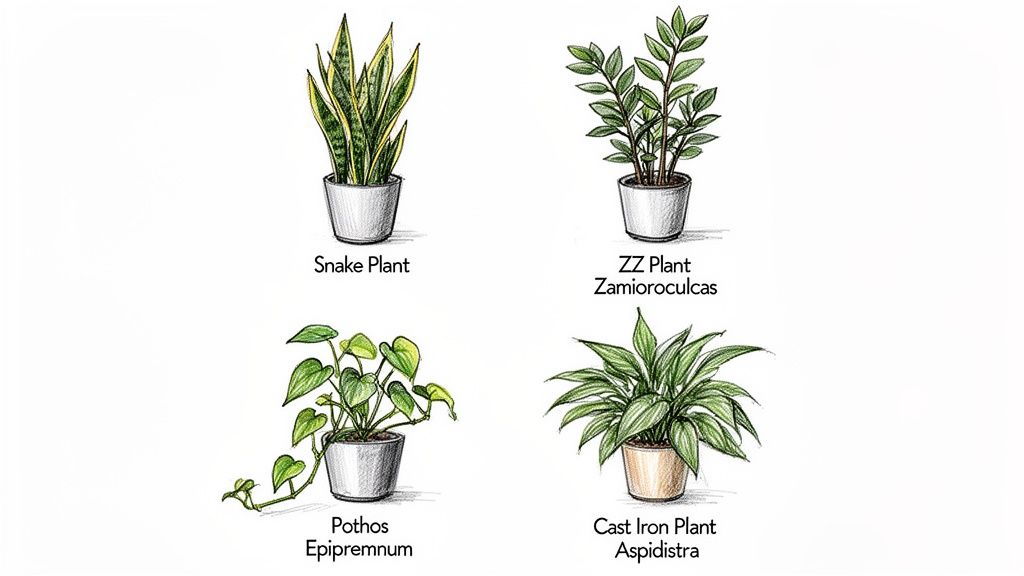
Each of these brings its own unique vibe to a room, but they all share one critical trait: they’re incredibly forgiving. They’re the perfect place to start if you’re looking to bring a bit of green into a space that doesn’t get a lot of sun.
The Unbeatable Snake Plant (Sansevieria)
If there was an award for the most indestructible houseplant, the Snake Plant would be a top contender, hands down. Its striking, upright leaves have a really strong, architectural feel, which is why you see it so often in modern interior design.
Snake Plants are actually succulents, storing water in those thick leaves. This means they’re exceptionally tolerant of drought and, more importantly, very prone to root rot if you get too generous with the watering can. It's the definition of a 'set and forget' plant—perfect for busy people or anyone just starting their plant journey.
The Resilient ZZ Plant (Zamioculcas zamiifolia)
The ZZ Plant is another absolute superstar in the world of houseplants low light. With its glossy, deep green leaves climbing up graceful, arching stems, it manages to look lush and vibrant even tucked away in a dim corner.
Much like the Snake Plant, the ZZ grows from rhizomes—swollen underground stems that are brilliant at holding onto water. This is what makes it so resilient to a bit of neglect and infrequent watering, especially during our cooler, darker New Zealand winters from June to August.
For many of us, the journey into low-light gardening starts with one of these hardy plants. Their knack for putting up with a huge range of conditions is a massive confidence booster and a great way to discover the joy of having plants indoors.
The Versatile Pothos (Epipremnum aureum)
Everyone knows the Pothos, with its lovely heart-shaped leaves and long, trailing vines. It's one of the most popular and adaptable houseplants you can get. You can pop it in a hanging basket, train it to climb up a support, or just let it cascade elegantly from a high shelf.
A quick note on its colour: while many Pothos varieties have beautiful variegation (patterns of cream, yellow, or white), you might notice these patterns fade in very low light. The plant will often revert to solid green to produce more chlorophyll and make the most of the limited light. This is a totally normal survival trick, not a sign that your plant is unhappy!
The Timeless Cast Iron Plant (Aspidistra elatior)
The Cast Iron Plant really, truly lives up to its name—it’s nearly impossible to kill. With its large, deep-green, lance-shaped leaves, it has a classic, sophisticated look that fits in just about anywhere. It was a favourite in gloomy Victorian parlours for a reason: it could handle low light, poor air quality, and general forgetfulness.
This plant is an exceptionally slow grower, so you won't be rushing to repot it every year. Its tolerance for just about everything, from deep shade to inconsistent watering, makes it one of the most dependable houseplants for low light you'll ever find. If you're keen to explore other great options, we've got more recommendations for good indoor plants for home.
To make choosing a little easier, here's a quick rundown of our low-light heroes.
Low Light Plant Comparison Guide
| Plant Name | Watering Needs | Tolerates Neglect? | Pet Friendly |
|---|---|---|---|
| Snake Plant | Very Low | Yes, absolutely | No, toxic if eaten |
| ZZ Plant | Very Low | Yes, thrives on it | No, toxic if eaten |
| Pothos | Low to Medium | Yes, very forgiving | No, toxic if eaten |
| Cast Iron Plant | Low | Yes, famously so | Yes, non-toxic |
This table should give you a good starting point. All these plants are brilliant for low-light situations, but their different needs—especially around pets—can help you pick the perfect one for your home.
Mastering Low-Light Plant Care in New Zealand
Looking after houseplants in low light is surprisingly simple once you get your head around one golden rule: less is almost always more. Because these plants are running on a slower, more energy-efficient setting, their needs are far simpler than their sun-worshipping cousins. Getting this balance right is the secret to a lush, green indoor space, even in the shadiest corners of your Kiwi home.
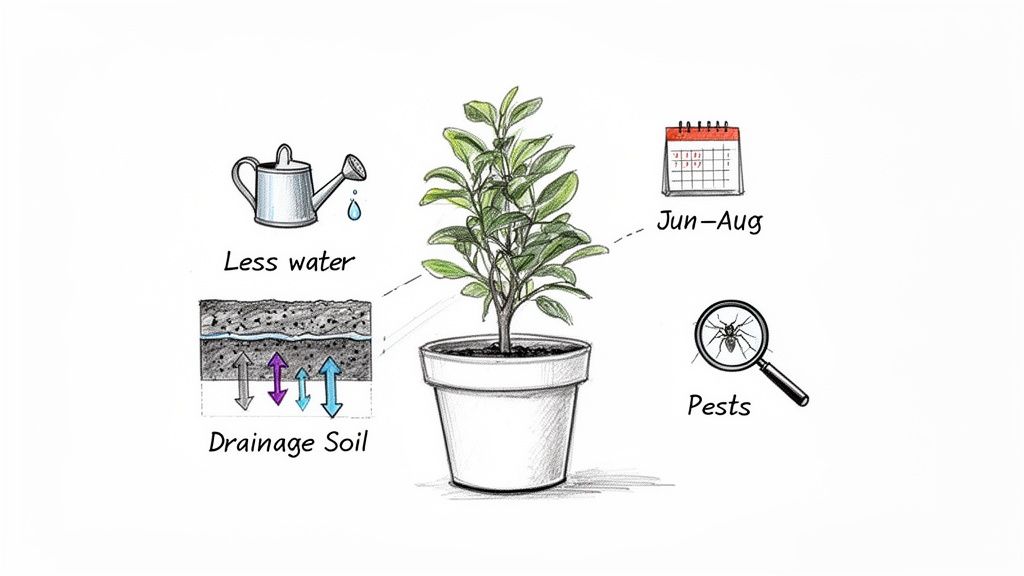
The single biggest mistake we see is overwatering. Since your plant is photosynthesising at a snail's pace, it drinks far less water. This is especially true during our cooler, darker New Zealand winters from June to August, when plant metabolism slows to a crawl.
The Right Way to Water
First things first, throw out any rigid watering schedules. The only reliable way to know if your plant needs a drink is to get your hands dirty.
Simply poke your finger about 5cm deep into the potting mix. If it feels damp, walk away. If it’s dry, then it’s time to water.
When you do water, do it properly. Give it a good soak until water runs freely through the drainage holes. This ensures every single root gets a chance to drink. Afterwards, make sure you tip out any excess water from the saucer or cover pot. Leaving a plant to sit in a puddle is a one-way ticket to root rot.
The core principle for watering low-light houseplants is to let them dry out significantly between drinks. It's far easier to save a thirsty plant than it is to rescue one that’s drowning from too much attention.
Soil and Feeding for Slower Growth
A well-draining potting mix is non-negotiable. A quality blend, often with chunky bits like perlite or bark, lets excess water escape and allows the roots to breathe. Using heavy, dense soil from the garden is a classic mistake that just creates a bog.
When it comes to feeding, you guessed it: less is more. Low-light plants aren't in a phase of active growth, so they need very little fertiliser.
- Growing Season: During spring and summer (September to February), you could feed them once every two months with a heavily diluted liquid fertiliser.
- Dormant Season: In autumn and winter (March to August), it’s best to stop feeding entirely while the plant is resting.
For a deeper dive, our complete guide to indoor plant fertilizer can help you pick the right product and technique.
Pests and Humidity
Low-light plants are generally pretty tough, but consistently damp soil can attract unwelcome guests like fungus gnats. These tiny flying insects are more of a nuisance than a real threat, but their presence is a flashing neon sign that your soil is staying too wet for too long. Letting the soil dry out properly is the most effective way to break their life cycle.
Most low-light champions, like Snake Plants and ZZ Plants, are perfectly happy with average household humidity. But if you have something that originates from a tropical understory, like a Calathea, it might appreciate a little boost from a nearby humidifier or a pebble tray—especially if you use a heat pump, which can really dry out the air.
How to Place and Style Your Low Light Plants
You’ve found the perfect plant, but that’s only half the job done. Figuring out exactly where to put it is what really brings your space to life. With a bit of creative thinking, you can turn those awkward, dim corners into lush green features that add a touch of nature to your home.
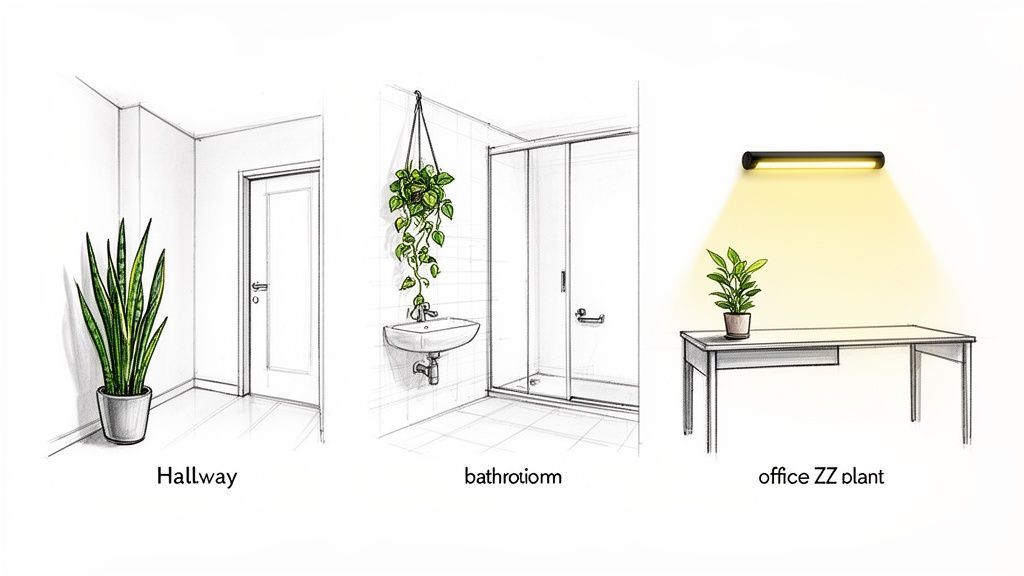
Think of low-light plants as your interior styling secret weapons. A tall, architectural Snake Plant can add some much-needed vertical drama to a forgotten hallway corner. A trailing Pothos is brilliant for softening the hard lines of a bookshelf or a bathroom cabinet that’s miles away from a window.
To really show off your low-light survivors, play around with different decorative elements. Try grouping plants with different heights and leaf textures to create a mini-jungle vibe, or pop a single stunning specimen on a stylish indoor plant stands to give it the spotlight it deserves.
Promoting Balanced and Healthy Growth
Once you’ve settled on the perfect spot, there’s a simple trick to keep your plant looking full and happy. Plants instinctively lean towards their light source, which, over time, can make them look a bit lopsided and sparse on one side.
To stop this from happening, just give your plant a quarter turn once a week. It’s a tiny bit of effort that encourages even, balanced growth all the way around. You’ll be rewarded with a much fuller, healthier-looking plant that looks great from every angle.
When Low Light Becomes No Light
But what about those truly dark places, like an internal bathroom or a deep hallway with absolutely zero natural light? Even the toughest houseplants low light champs can’t survive in complete darkness. For these spots, you’ll need to bring the sunshine indoors with a bit of help.
Don't worry, this doesn't mean you need to install some complex, industrial-looking setup. Modern LED grow lights are surprisingly affordable, energy-efficient, and designed to blend right into your home decor. Many are just simple screw-in bulbs that fit into standard lamps.
It's a common myth that grow lights need to be on 24/7. Just like us, plants need a period of darkness to rest and perform important metabolic processes. A simple timer set for 10-12 hours of light per day is all it takes to create a thriving green oasis, literally anywhere.
When you’re picking out a grow light, look for "full-spectrum" white LEDs. These are designed to mimic natural sunlight, providing all the light wavelengths your plant needs to photosynthesise without casting that weird purple or pink glow. This simple addition means you can put a plant in any room you want, windows or no windows.
Shopping for Low Light Plants in New Zealand
Ready to bring a new green friend home? Shopping for low-light houseplants in New Zealand can be a bit of a treasure hunt, and it helps to understand what makes our local market unique. You've probably noticed that some of the trendy plants you see online can be harder to find here, or they come with a surprisingly hefty price tag.
That’s largely down to New Zealand's world-class biosecurity system, which works hard to protect our incredible native flora. Our regulations are strict: any plant species not already present in the country before 29 July 1998 is considered a 'new organism'. Bringing these in requires a rigorous approval process with the Environmental Protection Authority (EPA), which naturally impacts availability and cost. Knowing this helps you appreciate the journey and value of the beautiful, locally grown plants we do have access to.
What to Look for in a Healthy Plant
Whether you're browsing in a nursery or clicking 'add to cart' online, it pays to put on your detective hat. A healthy, robust plant will have a much easier time settling into a shadier corner of your home.
Here’s a quick checklist to run through:
- Vibrant Foliage: Look for leaves that have a good, solid colour and feel firm to the touch. Steer clear of plants with yellowing leaves, brown spots, or sad, crispy edges.
- Pest-Free: Pests love to hide. Check the undersides of the leaves and the little nooks where the leaf meets the stem for any tiny insects or fine, spidery webbing.
- Healthy Roots: If you can, take a peek at the roots through the drainage holes. You want to see firm, whitish or light tan roots. If they look dark, black, or mushy, that’s a big red flag for root rot.
Acclimatising Your New Plant
Once you get your new plant home, the single most important thing to do is… nothing! I know it’s tempting to immediately repot it into a beautiful new planter, but the trip from the grower to your house is a big, stressful adventure for a plant.
Give your new plant at least a week or two to just chill out and acclimatise to its new home. Let it get used to the light, temperature, and humidity before you make any big changes like repotting.
This simple quarantine period gives it the best possible chance to adapt smoothly and set it up for a long, happy life with you.
If you’re looking for more inspiration, check out our guide to some other great indoor houseplants.
Got Questions About Your Low Light Plants? We’ve Got Answers.
We field a lot of questions about looking after houseplants in low light, so I've put together the most common ones we hear. Hopefully, this clears a few things up and helps you keep your green mates thriving.
Can a Houseplant Really Survive with No Windows at All?
In short, no. No plant can live in complete darkness. When we say a plant is ‘low light tolerant’, it means it can handle being quite a distance from a window. But a room with zero natural light will always need a proper grow light to keep any plant alive and well for the long haul.
Help! Why Are My Plant’s Leaves Turning Yellow?
Nine times out of ten, yellowing leaves on a low light plant scream "overwatering!" Because these plants grow so slowly, they're incredibly water-efficient and don't need much. Before you even think about watering, check that the top 5cm of soil is properly dry. You'll definitely need to cut back on watering during the New Zealand winter, from about June to August.
My Snake Plant Hasn't Grown an Inch in Months. Is It Okay?
Yes, that’s totally normal and exactly what you should expect. Plants in low light aren't in a growth spurt; they're in survival mode. They conserve all their energy just to maintain themselves. As long as the leaves are firm, standing tall, and there are no signs of mushy rot, your Snake Plant is perfectly happy and doing its thing.