
When it comes to giving your lemon tree a good prune, timing is everything. Get it right, and you'll be rewarded with a healthy, productive tree. Get it wrong, and you could be inviting pests or setting your tree back.
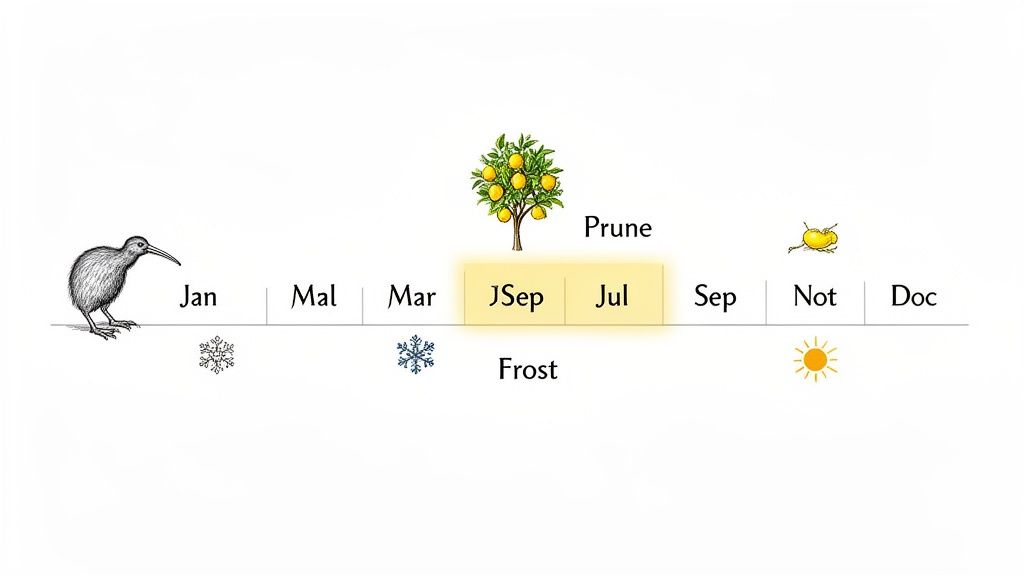
So, when is the best time for a proper structural prune here in New Zealand? The sweet spot is late winter through to early spring – think July to September. You can do a bit of light trimming here and there at other times, but the main haircut should happen then.
The Best Time to Prune Your Lemon Tree in New Zealand
Figuring out the perfect moment to get the loppers out can feel like a bit of a guessing game, but it’s actually pretty straightforward once you understand why you're waiting. It’s all about working with the seasons and your tree’s natural cycle, not against it.
For us Kiwi gardeners, that late winter/early spring window is golden. Pruning then means you’re getting in just after the last of the hard frosts but right before the tree kicks into its vigorous spring growth. This timing allows the tree to heal quickly and channel all that new energy into producing healthy growth and, eventually, more lemons.
Why Late Winter and Early Spring Work Best
Pruning when your lemon tree is semi-dormant offers some real advantages:
- It minimises stress. When the tree isn't actively growing, cutting back branches is less of a shock. It can then put its energy reserves into healing the cuts and pushing out fresh growth when spring arrives.
- You avoid frost damage. Fresh pruning cuts are quite vulnerable. A sudden hard frost can damage the exposed wood, causing it to split and die back. Waiting until the worst of the cold has passed protects your tree.
- It deters pests. This is a big one. The notorious lemon tree borer is most active in the warmer months. Pruning in the cool of late winter means the scent from the fresh cuts is less likely to attract these pests before the wounds have a chance to seal over.
This isn't just a backyard gardener's trick; it's standard practice across New Zealand's commercial citrus orchards. In major growing regions like Northland and Gisborne, growers prune lemon varieties like Yen Ben from June to August specifically to sidestep the borer's active season. It dramatically cuts the risk compared to pruning in spring or autumn.
A well-timed prune is one of the most effective, non-chemical ways to manage pests. By pruning from July to September, you’re basically taking away the 'welcome mat' for the lemon tree borer, whose larvae love to tunnel into fresh cuts made in warmer weather.
Of course, New Zealand has a varied climate. If you're gardening up in a warmer, frost-free part of the North Island, you've got a bit more flexibility and can probably get away with pruning earlier in winter. Down south, you'll want to wait until you're absolutely sure the risk of a hard frost has passed.
The basic principles are pretty similar for most fruit trees, which you can learn more about in our general guide on how to prune fruit trees.
To make it even simpler, here's a quick seasonal rundown of what you should be doing with your lemon tree and when.
NZ Lemon Tree Pruning Calendar at a Glance
| Season | Timing (NZ Months) | Primary Pruning Task | Reason |
|---|---|---|---|
| Winter | June - August | Main structural prune. Remove dead, damaged, or crossing branches. Shape the tree. | The tree is dormant, minimising stress. Avoids the peak lemon tree borer season. Wait until late winter in frost-prone areas. |
| Spring | September - November | Light tidy-up only. Remove any new water shoots or suckers. | The tree is in a vigorous growth phase. Major pruning now can remove new fruiting wood and stress the tree. |
| Summer | December - February | Minimal trimming. Snip off any dead twigs or branches that have finished fruiting. | Avoid major cuts as the lemon tree borer is highly active. The tree is focused on fruit development. |
| Autumn | March - May | Post-harvest tidy-up. Lightly prune to remove spent fruiting wood and maintain shape. | A good time for a light trim after the main harvest, but avoid heavy pruning as new growth may not harden before winter. |
This calendar gives you a great starting point. Just remember to always watch your own tree and local conditions—gardening is as much an art as it is a science
The Right Tools for a Clean Cut
Right, before you even think about making that first snip, let’s talk gear. Getting your tools sorted is half the battle. Using blunt or dirty equipment is a surefire way to damage your tree, invite disease, and turn a pleasant afternoon job into a real slog. A few quality items, though, will see you right for years to come.
Your basic lemon-pruning toolkit really only needs three key players. Each has a specific job, making sure you get clean, precise cuts without wrestling with the tree or tearing the bark.
The Essential Pruning Trio
For most backyard lemon trees, you can get everything done with just these three tools:
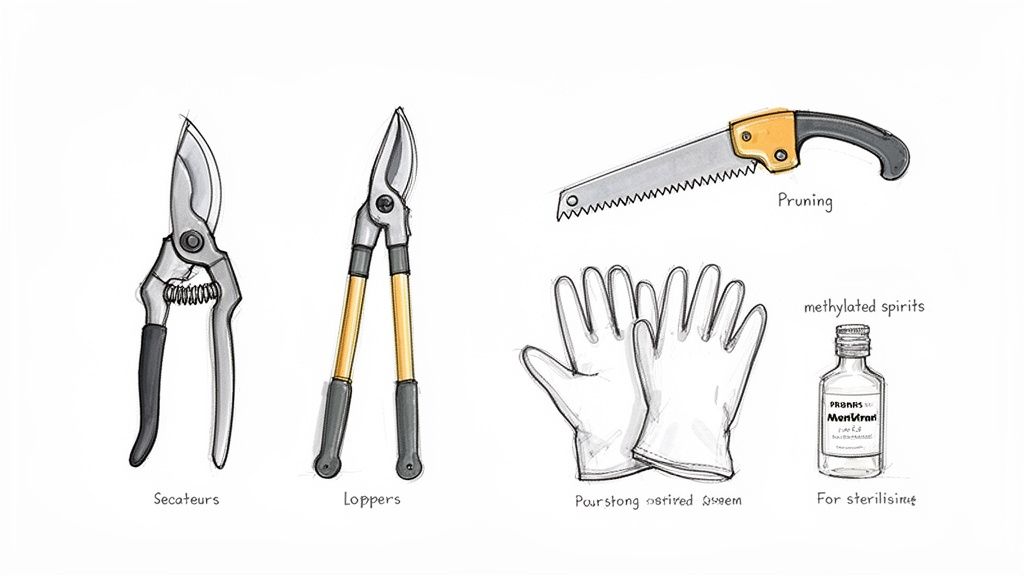
- Bypass Secateurs: These will be your best friend for trimming small stems and twigs, usually anything up to about 1.5 cm thick. They work just like a pair of scissors, with one sharp blade bypassing a thicker one to make a really clean cut that heals up nicely. A quality pair of pruning scissors is something you'll use all over the garden.
- Loppers: Think of these as secateurs on steroids. The long handles give you the leverage needed to chop through thicker branches—generally from 1.5 cm up to 4 cm—without breaking a sweat.
- Pruning Saw: When you come across a branch that’s too beefy for your loppers, it’s time to bring out the pruning saw. These are designed to cut on the pull stroke, which gives you much better control and stops the blade from jamming or buckling.
Tool Hygiene and Safety
Now, this is the step that so many people skip, but it’s absolutely critical. Diseases can spread like wildfire from one plant to another on dirty blades. Before you start pruning, and especially when moving between different trees, give your tools a quick clean.
A simple wipe-down with methylated spirits or a dip in a weak bleach solution (one part bleach to ten parts water) is all you need to sterilise your gear. It’s a small habit that makes a massive difference in preventing the spread of nasty fungal and bacterial problems.
And finally, a word on your own safety. A good, sturdy pair of gardening gloves is a must to protect your hands from those surprisingly sharp lemon thorns. I’d also recommend popping on some safety glasses to keep your eyes safe from any wayward twigs. A few simple precautions mean you can get the job done safely and effectively.
A Practical Pruning Method for Every Lemon Tree
Alright, with your tools clean and ready, let's get into the nitty-gritty of how and, just as importantly, why we prune lemon trees. Don't think of it as a rigid set of rules. It’s more like a conversation with your tree, where you’re gently guiding its growth for better health, airflow, and of course, more delicious lemons.
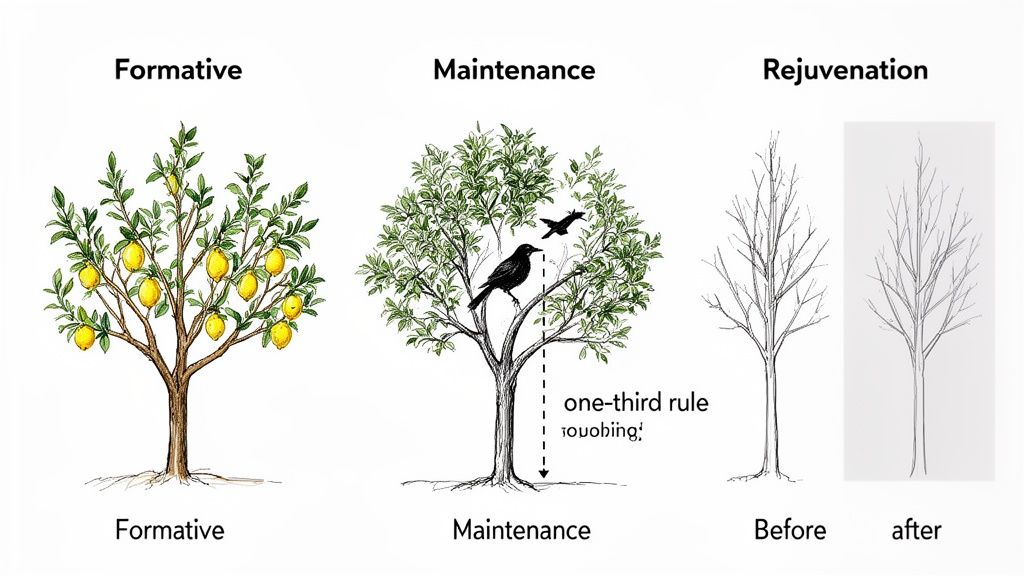
Every tree is at a different point in its life, so a one-size-fits-all approach just doesn't cut it. We’ll walk through the three main scenarios you're likely to find in your own Kiwi garden: shaping a young tree, maintaining an established one, and reviving a gnarly old lemon tree that’s seen better days.
Formative Pruning for Young Trees
When you first plant a young lemon tree, your goal isn't about getting fruit straight away—it's all about building a solid structure. Formative pruning is how you establish a strong, open framework that will support heavy crops for decades. Think of it as laying the foundation for a long and fruitful life.
The aim here is to create an open 'vase' shape, with three to five strong, well-spaced main branches coming off the trunk. This shape is fantastic for letting sunlight and air right into the centre of the tree, which helps ripen fruit beautifully and slashes the risk of fungal diseases.
- First Winter/Spring: After planting, pick out your main 'scaffold' branches. Remove any others that are weak, poorly positioned, or growing too close together.
- Following Year: Trim these main branches back by about one-third to encourage strong sideways growth. And be sure to snip off any new shoots that are growing back towards the centre of the tree.
This little bit of guidance early on pays massive dividends later, preventing weak, overloaded branches from snapping under the weight of a bumper lemon crop.
Annual Maintenance Pruning for Established Trees
For a mature, healthy lemon tree, your annual prune is basically a yearly tidy-up to keep it in prime condition. The best time for this is in that late winter to early spring window we talked about.
Your focus here is on the 'Three Ds':
- Dead: Any branches that have completely died back. They’re just taking up space and can become a home for pests and diseases.
- Damaged: Branches broken by wind or splitting under their own weight. Cut them back to healthy, solid wood.
- Diseased: Any wood showing signs of trouble, like cankers or strange discolouration. Always cut back well into the healthy tissue.
Once you’ve dealt with the 'Three Ds', step back and have a good look. Are any branches crossing over and rubbing against each other? That rubbing creates wounds that are an open invitation for pests. You’ll also want to remove any branches growing inwards, as they just block up that crucial airflow.
There's an old gardener's saying: prune your tree so a bird can fly through the middle without its wings touching the branches. It’s fantastic advice because it perfectly sums up the goal—an open, airy canopy where sunlight can reach every single part of the tree.
This is exactly what commercial growers do, too. In Gisborne, which produces over 65% of New Zealand's citrus, they prune Yen Ben lemons in late winter to open up the canopy. Just improving the airflow like this has been shown to reduce problems like sooty mould and citrus whitefly by 30-50% in dense trees.
Rejuvenation Pruning for Neglected Trees
Have you inherited an old, overgrown lemon tree that’s more of a tangled mess than a productive plant? Don’t give up on it! A careful, strategic prune can bring it back from the brink, but you’ll need to be patient.
The key is not to do too much at once. Hacking an old tree back severely will just shock it, causing a wild flush of weak, leafy 'water shoots' and very few lemons. Instead, you want to spread the renovation over two to three years.
A great rule of thumb to follow is the 'one-third rule': never remove more than one-third of the tree’s total canopy in a single year.
- Year One: Start with the 'Three Ds'—get rid of all the dead, damaged, and diseased wood. Then, identify a few of the oldest, least productive main branches and remove them completely.
- Year Two: The tree will have responded with new growth. Your job is to select the strongest, best-placed new shoots to form the new framework and remove the weaker ones. You can also take out another one or two of the old, tired branches.
- Year Three: By now, you’re just refining the shape. Continue removing the last of the old, problematic wood and encourage the new structure you’ve been building.
Taking this slow and steady approach lets you transform a neglected tree back into a healthy, manageable, and fruit-bearing star of the garden without causing it a whole lot of stress. To make sure you’re using the best techniques, it's worth learning about the 8 essential methods for trimming limbs on trees which can really help refine your approach.
Common Pruning Mistakes Kiwi Gardeners Make
Even the greenest thumbs can make a slip-up now and then, but when it comes to your lemon tree, a few common mistakes can really set you back. Steering clear of these pitfalls is the secret to keeping your tree healthy, productive, and safe from some uniquely Kiwi threats.
One of the biggest blunders I see is simply pruning at the wrong time of year. A light trim in summer might seem harmless, but making any substantial cuts during the warmer months is like sending an open invitation to a nasty native pest: the lemon tree borer. This is a massive issue for anyone wondering when to prune lemon trees in NZ, as our local pest cycles really dictate the safest timing.
In regions like the Waikato, for instance, the borer is buzzing about from spring right through to autumn. Local arborists I've spoken with have seen summer pruning lead to 20-30% branch loss from borer damage, as the larvae happily burrow into those fresh wounds. To dodge this bullet, you absolutely must schedule your main prune for the winter months, typically June to August, when the borer is dormant. The team at Marc Doyle Treework's blog have some great insights on managing this regional pest.
Over-Pruning and Its Consequences
Another classic mistake is getting a bit too enthusiastic with the secateurs. It’s tempting to give the tree a hard haircut, thinking you’re doing it a favour. The reality? Removing more than one-third of the canopy at once can send the poor thing into shock.
This stress triggers a survival mode, where the tree pushes out a massive flush of weak, vertical stems known as water shoots or suckers. They grow incredibly fast, but they almost never produce fruit and just drain the tree’s energy away from making lovely lemons.
A good prune is a thoughtful one. The goal is to gently guide the tree's shape and health, not to butcher it. Step back often, look at the overall shape, and make sure you're not getting carried away.
Making Incorrect Cuts
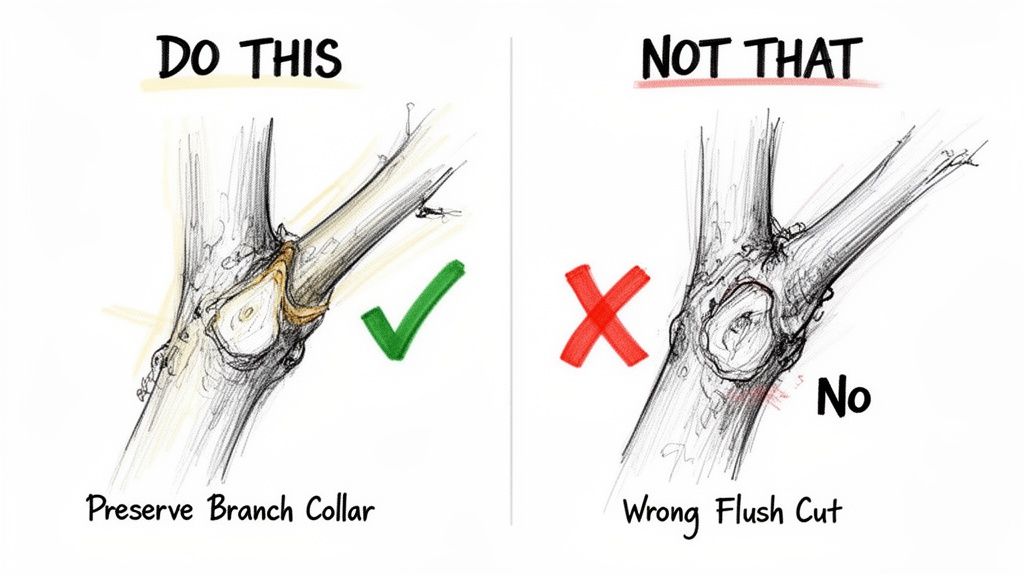
How you make each cut is just as crucial as when you make it. A widespread mistake is the flush cut, where a branch is sliced off right up against the main trunk or a larger limb. It might look tidy, but this is a seriously damaging practice.
A flush cut removes the branch collar – that slightly swollen, wrinkled area of tissue at the base of a branch. This collar contains specialised cells that are absolutely essential for healing. By cutting into it, you create a large wound that the tree can’t seal over properly, leaving it wide open to rot and disease.
Here’s a simple "do this, not that" guide for your cuts:
- DON'T: Cut flush against the trunk. This creates a huge, slow-healing wound that invites trouble.
- DO: Find the branch collar and cut just outside it, leaving a small stub. This lets the tree form a protective ‘doughnut’ of scar tissue over the wound, sealing it off cleanly and efficiently.
Caring for Your Lemon Tree After Pruning
Once you’ve put the clippers away, your job isn't quite finished. Proper aftercare is what really turns a good prune into a great one, setting your lemon tree up for a vigorous recovery and, hopefully, a fantastic future harvest. Think of it as giving your tree the perfect recovery meal after its big haircut.
After a major winter prune, your tree is basically coiled like a spring, ready for an explosion of new growth. Giving it a good feed right away provides the fuel it needs for this crucial period. A balanced, slow-release citrus fertiliser is the ideal choice to support this burst of energy.
Feeding for a Strong Recovery
When you're choosing a feed, look for one specifically formulated for citrus. These mixes contain the right balance of the big three nutrients: nitrogen (N) for leafy growth, phosphorus (P) for root development, and potassium (K) for flowering and fruiting. Crucially, they also include vital trace elements.
- Key Nutrients: A good citrus food will also have magnesium and iron, which are essential for preventing the all-too-common problem of yellowing leaves. If you notice persistent yellowing even after feeding, you might want to learn more about tackling lemon tree leaves turning yellow in our detailed guide.
- Application Method: The best way to apply granular fertiliser is around the drip line of the tree—that’s the circle on the ground directly underneath the outermost branches. This is where the most active feeder roots are located. Gently scratch the granules into the soil surface and then water them in well.
Smart watering is just as important as feeding. Instead of light, frequent sprinkles, give your tree a deep, thorough soaking less often. This encourages the roots to grow deeper into the soil, which makes the tree far more resilient and drought-tolerant in the long run.
To Seal or Not to Seal Pruning Wounds
The debate over using pruning sealants or pastes on cuts is a long-standing one among gardeners. While it might seem logical to cover a wound to protect it, modern gardening advice generally leans against it for most situations here in New Zealand.
For small to medium-sized cuts (less than a few centimetres across), it's almost always best to let them heal naturally. Trees have their own amazing mechanisms for compartmentalising wounds and sealing them off from disease.
Leaving the cuts exposed to fresh air often leads to quicker, cleaner healing. It also reduces the risk of trapping moisture under a sealant, which can ironically encourage fungal growth. For a broader understanding of lemon tree health, there are some great resources available on general lemon tree care.
A Few Common Questions About Lemon Tree Pruning
Even with the best guide in hand, there are always a few tricky situations that pop up. Let's tackle some of the most common questions I hear from fellow Kiwi gardeners about getting their lemon tree pruning just right.
Can I Prune My Lemon Tree in Summer in New Zealand?
This one comes up a lot, especially when a branch starts blocking the path to the clothesline. While it’s tempting, you need to be very careful with summer pruning.
You can get away with a tiny bit of trimming—snipping off a dead twig or a stem where you've just picked a lemon. But you must avoid any major cuts between December and February.
Why? The lemon tree borer. This nasty native pest is at its most active in the warmth and is drawn to the scent of fresh pruning cuts. Sawing off a decent-sized branch in summer is basically sending them a dinner invitation, and they can do some serious, lasting damage. It's best to stick to minor tidy-ups and save the real work for the cooler months.
My Lemon Tree Has Yellow Leaves, Should I Prune It?
Seeing yellow leaves can be a bit worrying, but reaching for the secateurs is almost never the right first move. Yellowing leaves are your tree’s way of telling you it’s unhappy about something else—usually a nutrient shortage (often magnesium or nitrogen) or a watering issue.
Pruning a tree that's already under stress is counterproductive. It just forces the poor thing to divert its limited energy into healing wounds instead of fixing the root cause of the problem.
Your first job is to play detective and fix what's causing the yellowing. A good dose of citrus fertiliser and a review of your watering schedule is the place to start. Once the tree bounces back with healthy new growth, then you can think about pruning in the correct season.
How Do I Prune a Lemon Tree in a Pot?
Pruning a lemon tree in a pot or container isn't all that different from one in the garden, but your focus shifts to keeping it a manageable size. The aim is to keep the tree compact and productive without letting it get out of hand.
Here's what to concentrate on:
- Keep the Centre Open: Good airflow is your best friend when it comes to preventing pests and diseases, especially in the confined space of a pot. Regularly thin out the central branches to let light and air in.
- Control the Size: Don't be shy about trimming back branches that are getting a bit long or leggy. This helps maintain a nice, balanced shape that suits the container.
- Remove Weak Growth: Any spindly little shoots or suckers popping up from the base are just stealing energy. Snip them off as you see them to push all that goodness into making fruit.
What Should I Do with the Pruned Branches?
Cleaning up your clippings properly is a crucial final step. What you do with them depends entirely on their condition.
Healthy, disease-free branches and leaves are gold for your compost bin. Just chop them into smaller bits so they break down faster.
However, if you’ve cut off any wood showing signs of trouble—like borer tunnels, cankers, or the scabby marks of verrucosis—that needs to be handled with care. Never compost diseased material. The best thing to do is burn it (if you can) or bag it up and put it in your general waste bin. This stops any pests or diseases from making a home in your compost and spreading through the rest of your garden.
At Jungle Story, we're all about helping Kiwi gardeners grow with confidence. From the perfect pair of secateurs to the right citrus fertiliser, find everything you need to keep your lemon tree happy and healthy by exploring our online marketplace at https://junglestory.co.nz.