
Persimmon trees have found their sweet spot in New Zealand’s temperate climate. With their glossy leaves, vibrant autumn colour and sugary winter fruit, they bring year-round charm to any garden.
Hardy and adaptable, these trees naturally shift their flowering and pruning cycles to our June–August winter. That makes them a perfect choice for home orchards from Northland down to Otago.
Why Persimmon Trees Suit New Zealand Gardens
Adding persimmons to your patch combines beauty with bounty. Once they’re established, you’ll enjoy both ornamental appeal and delicious harvests.
Though native to Asia’s warmer zones, persimmons quickly acclimatise to our Kiwi microclimates. From breezy coastlines to sheltered inland valleys, they flourish under New Zealand skies.
This guide lays out every essential step, from choosing the right cultivar to mastering pest control in your own backyard. You’ll follow a clear roadmap that aligns with our southern-hemisphere seasons.
Key Benefits:
- Year-Round Interest: Glossy foliage and striking autumn colour.
- Seasonal Harvests: Sweet fruit ripens just as the weather cools.
- Adaptability: Thrives in everything from coastal gardens to inland plots.
- Low Maintenance: Minimal pruning and feeding once settled.
In the sections ahead, you’ll learn how to pick the best cultivars, plant your tree correctly and keep it thriving through every season.
What To Expect In Each Chapter
Chapter One covers site selection and cultivar choices, comparing chilling requirements and fruit textures. You’ll discover why some varieties prefer a cooler winter and how they differ in taste.
Next, we dive into planting: soil preparation, nutrition schedules and support strategies for robust roots. You’ll find step-by-step instructions that even first-time growers can follow.
The seasonal care segment breaks down monthly pruning, pest and disease management, plus harvest and curing techniques. Think of it as your persimmon calendar.
“Persimmons bring reliable yields and stunning autumn colour to NZ gardens, even in cooler regions.”
Finally, we explore propagation methods, design ideas for your landscape and tips on sourcing quality trees from trusted nurseries. You’ll know exactly where to find the best stock.
Learn more in our in-depth guide on fruit trees in NZ’s temperate gardens. It’s a helpful companion for any fruit-growing enthusiast.
By the end of this introduction, you’ll feel confident tackling each step. Let’s transform your backyard into a productive persimmon orchard that delights with flavour and colour.
Happy growing and enjoy the journey!
Understanding Persimmon Industry In NZ
New Zealand’s persimmon sector may span only a few hundred hectares, but it punches well above its weight when it comes to quality. Growers in Gisborne, the Bay of Plenty and Northland craft every orchard block much like boutique wineries do—meticulously and with care.
Behind the scenes, cold–treatment facilities and strict packhouse protocols ensure each fruit meets phytosanitary standards for markets from Australia to Japan. Meanwhile, efficient sea-freight operations carry thousands of tonnes every year, underscoring how vital a reliable cold chain really is.
Despite pandemic-related export hiccups, the industry bounced back quickly—a testament to how preparation pays off. Small-scale and backyard growers can learn from these commercial operations to elevate their own post-harvest practices.
- Cold-treatment facilities control temperature regimes for target markets
- Sea-freight handles 76% of exports, demanding extended cold-chain management
- Four MPI-registered packhouses (run by two operators) supply China and other destinations
“Cold-chain readiness is as crucial to persimmon export as sunshine is to sugar content,” notes a packhouse manager.
Orchard Technology And Logistics
High-tech orchards now use scanning equipment to grade fruit by firmness and sugar level in real time. Automated loading systems mean containers leave packhouses the moment fruit is ready, cutting losses and guaranteeing consistency.
For roadside growers, a small cooling room can be a game-changer. By matching harvest windows to transport schedules, growers collaborate with exporters and logistics providers to minimise delays at the port.
Key considerations include:
- Coordinating harvest timing with shipping windows
- Passing MPI inspections before dispatch
- Aligning labour availability with packing deadlines
Tracking export permits and phytosanitary certificates becomes part of the seasonal routine—a simple step that ensures each persimmon can reach its destination without hiccups.
Export Trends And Market Access
From 15 tonnes in 2018 to 45 tonnes in 2020 under special programmes, persimmon exports have shown remarkable growth. Annual shipments now hover around 1,000–1,200 tonnes, illustrating steadily rising demand abroad.
Pandemic restrictions did suppress volumes in 2020–22, but by 2023 exports nearly hit 1,000 tonnes again. Sea-freight continues to dominate with 76% of the share, so maintaining a tight cold chain remains essential.
For a deeper dive into trade figures, check out this report from Produce Report.
Below is a quick summary that brings these figures into focus.
Industry Metrics And Facilities
Here’s a snapshot of New Zealand’s persimmon industry at a glance. These metrics highlight production scale, output and export patterns.
New Zealand Persimmon Industry Metrics
| Metric | Value | Notes |
|---|---|---|
| Production Area | 300 ha | Concentrated in Gisborne, Bay of Plenty and Northland |
| National Output | 2,000 t | Peak pre-pandemic yield |
| Export Volumes | 1,000–1,200 t | Annual shipments in recent seasons |
| Sea-Freight Share | 76% | Dominant export method |
This snapshot reveals where the greatest opportunities lie—especially in refining cold-chain steps and expanding packhouse capacity.
Backyard growers can apply these lessons by investing in small-scale cool stores, sorting fruit by firmness and sugar levels, and keeping a simple temperature log. Even a basic packing bench with a thermometer can make a big difference.
By mirroring commercial quality-control protocols, home orchardists strengthen New Zealand’s reputation for top-tier persimmons. In our next section, we’ll dive into selecting the right cultivars for your local climate.
Selecting Persimmon Cultivars for NZ Climates
Choosing the right persimmon feels a bit like finding the perfect surf break—location matters. What thrives on a chilly Southland slope might sulk in Northland’s subtropical warmth. Matching cultivar to microclimate sets you up for healthy growth and top-quality fruit.
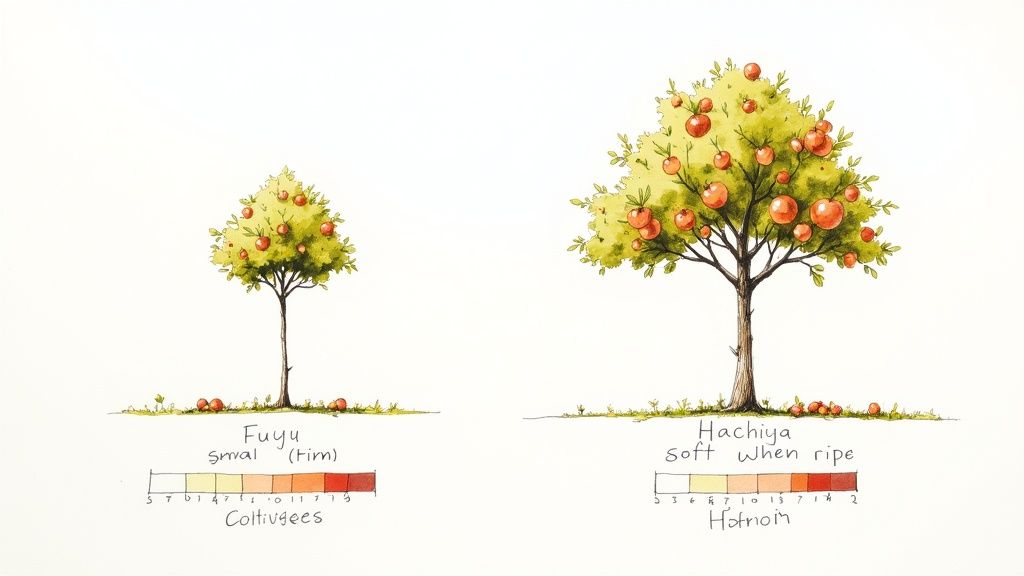
To keep things straightforward, persimmons generally fall into three taste-and-texture camps:
- Fuyu: Early-ripening, firm and crunchy—perfect for snacking or tossing into salads.
- Hachiya: Needs to soften before eating but boasts a creamy, pudding-like mouthfeel.
- Semi-Astringent: Offers a middle ground—still crisp yet with a gentle sweetness when mature.
“Selecting the right variety can boost yield by up to 20%, according to industry reports.”
These categories are a great starting point, but don’t forget to factor in frost tolerance and chilling hours for your region.
Comparing Chilling Requirements And Frost Tolerance
Winter chill hours tell you how long a tree needs cold weather to kickstart spring growth. For instance, Fuyu usually asks for 200–300 hours, whereas Hachiya often requires 400–500 hours.
Local breeders have introduced low-chill types that break dormancy with under 150 hours, ideal for Tauranga or Northland’s milder winters.
- Low-Chill Cultivars: 150–250 hours
- Mid-Chill Cultivars: 300–400 hours
- High-Chill Cultivars: 400+ hours
| Cultivar | Chilling Hours | Frost Tolerance | Harvest Window |
|---|---|---|---|
| Fuyu | 250 h | Moderate | Mar–Apr |
| Hachiya | 450 h | Low | Apr–May |
| Local NZ | 180 h | High | Feb–Mar |
Matching Size Yield And Garden Space
In a compact city garden, a full-size persimmon (4–6 m) might overwhelm your backyard. Dwarf or espaliered forms, staying under 3 m, keep fruit within arm’s reach and pruning a breeze.
- Measure Space: Take note of sun angles and canopy room.
- Estimate Yield: Full-size trees average 50–70 kg; dwarfs give 20–30 kg.
- Schedule Harvest: Late summer through early autumn in the southern hemisphere.
New Zealand’s commercial persimmon sector covers just 136 hectares, mainly around Gisborne, Northland and Auckland. In 2020 growers produced roughly 2,000 tonnes, exporting about 75% of that volume. For more stats, see the Figure NZ chart.
Sourcing Certified Nursery Stock
Healthy trees start life in a top-notch nursery. Seek out suppliers offering grafted, virus-free plants on sturdy rootstocks.
- Look for nursery certification labels.
- Confirm rootstock compatibility with your soil type.
- Verify cultivar authenticity so you get the fruit characteristics you expect.
Local growers report graft failures drop from 15% to under 5% when using certified stock.
Grower Success Stories
In Gisborne, a home orchardist pulled in 60 kg of Fuyu fruit per tree by Year 4—proof that patience pays off.
Nearby in Hawke’s Bay, similar results underline how choosing the right cultivar can steadily boost both productivity and profit.
Follow these guidelines, and you’ll be savouring sun-sweet persimmons and vivid autumn foliage before you know it.
Site Preparation And Nutrition Guidance
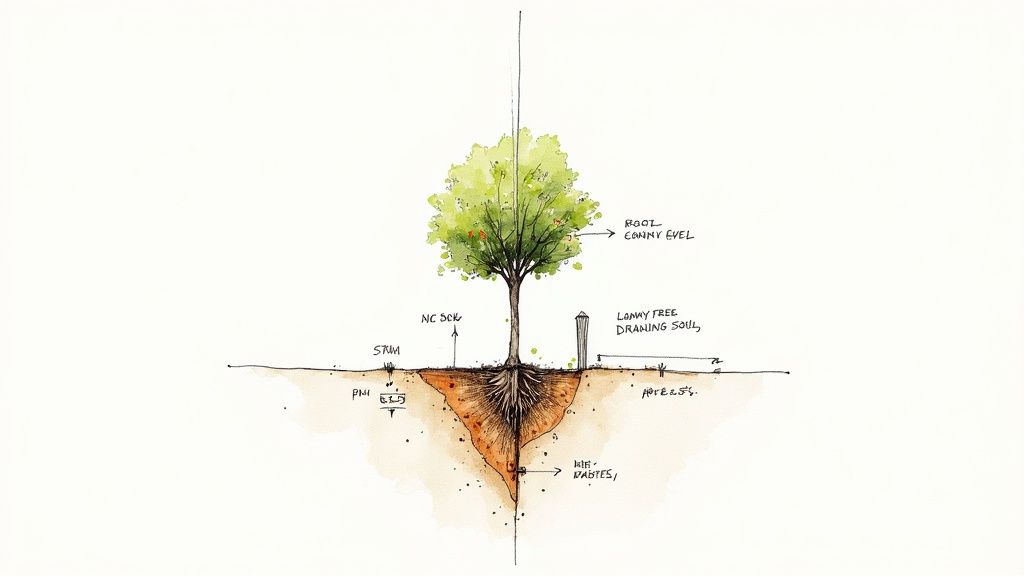
When you’re choosing where to plant your persimmon, think like a coach picking a training ground. You need full sun and just enough shelter from wind to let delicate young roots settle in.
Treat your soil as you would an athlete’s daily meal—consistent, balanced nutrients will keep your tree strong year after year. Start by gathering soil samples so you know exactly what you’re feeding your roots.
“Maintaining soil pH between 6.0–6.5 is essential for persimmon root health,” advises our horticultural specialist.
Collecting And Testing Soil Samples
Collecting soil isn’t guesswork; a few simple steps will give you the data you need.
- Choose 8–10 evenly spaced spots across your future orchard.
- Remove any surface debris, then use a clean spade or probe to take slices from the top 10–15 cm.
- Mix all samples in a clean bucket before transferring to a labelled bag for the lab.
When the report comes back, you’ll know if your pH needs correcting. If it dips below 6.0, spread agricultural lime. If it climbs above 6.5, a light dusting of elemental sulphur will do the trick. And don’t forget organic matter—a 2:1 ratio of compost to soil can work wonders for moisture retention.
Preparing The Planting Site
Next, let’s talk drainage. Dig a test hole and fill it with water. If it drains in under 30 minutes, you’re in good shape. Otherwise, consider adding a layer of coarse gravel beneath the root zone to keep water from pooling.
Our arborist often says, “Site selection is as important as feeding schedules.” Space your persimmon trees at least 4 metres apart. This gap allows air to circulate, lowering the risk of fungal issues. Aim to shield them from cold southerly winds, particularly during flowering and fruit set.
Essential Nutrients For Young And Mature Trees
Just like athletes, young persimmons need a protein-rich diet early on. In early spring, apply a balanced 10-5-5 fertiliser when buds start to swell. This nitrogen boost helps build a sturdy canopy.
As summer wanes and fruit begins to set, switch to a bloom-friendly mix. A 5-10-10 formula, higher in phosphorus and potassium, encourages strong flowers and sweeter fruit. For a complete feeding schedule, check our detailed guide on fertilisers for plants.
| Stage | NPK Ratio | Application Timing |
|---|---|---|
| Establishment | 10-5-5 | Early Spring |
| Pre-Flowering | 5-10-10 | Mid-Summer |
| Post-Harvest | 8-4-8 | Late Autumn |
Once your soil is prepped and your feeding plan is in place, planting day arrives. Follow these quick tips:
- Dig a hole twice as wide as the root ball without going deeper.
- Set the root flare flush with the soil surface to prevent collar rot.
- Anchor a stake on the windward side and tie the trunk loosely.
- Backfill with your amended soil blend, then gently firm the ground.
- Hook up drip irrigation to deliver 10–15 mm of water per week in dry spells.
Finish with a 5–7 cm layer of organic mulch around the base, keeping it a few centimetres clear of the trunk. This simple blanket helps the soil hold moisture and stay at a steady temperature.
By choosing the right spot, testing and adjusting your soil, and fine-tuning your nutrition, you’ll set your persimmon trees up for a lifetime of health and bountiful harvests. Enjoy!
Seasonal Care And Pruning Strategies
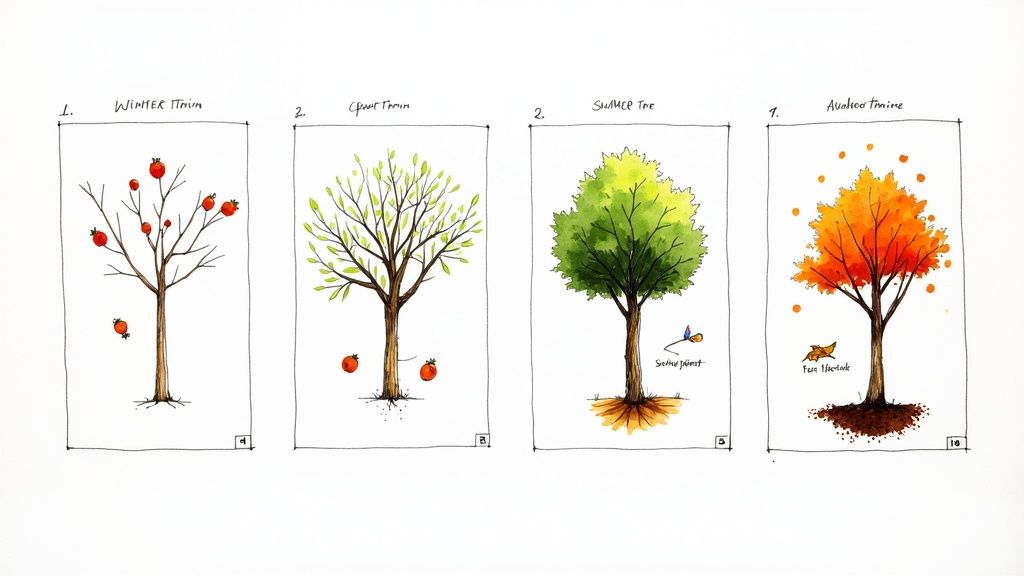
In New Zealand, persimmon trees rest through June to August, flipping the northern-hemisphere calendar on its head. When winter arrives, a well-timed prune sends energy straight into the buds, setting the stage for spring vigour.
As summer rolls in—particularly January and February—we switch gears to thinning and shaping. Think of it like training a vine, opening up the canopy so breeze and sun can dance through every fruiting spur.
By autumn, your tree is ready for a cosy layer of mulch. It’s like wrapping an athlete in a recovery blanket, locking in moisture before the cooler months.
- Winter Dormant Cuts remove weak or crossing branches and redirect sap.
- Summer Crown Thinning boosts airflow and light penetration.
- Autumn Mulching stabilises soil moisture and shields roots.
Seasonal Persimmon Care Calendar
Refer to the Seasonal Persimmon Care Calendar below to keep your persimmon tree in top shape throughout the year.
| Month | Task | Key Tips |
|---|---|---|
| June–August | Prune dead or crossing branches | Use bypass secateurs for clean cuts; disinfect between trees |
| September | Apply balanced fertiliser | A 10-5-5 mix supports bud development before flowering |
| October | Light thinning after bud break | Remove crowded shoots to channel sap to main branches |
| January | Mid-summer shoot tipping | Cut back vigorous water sprouts for canopy balance |
| February | Final thinning before fruit set | Keep 3–5 leaves per shoot to encourage larger persimmons |
| March–May | Mulch with organic compost | Spread 5–7 cm around the drip line, stay clear of trunk base |
Following this calendar helps you stay on track with pruning, fertilising, mulching and more, so your tree can thrive.
Winter Pruning Techniques
When the tree is fully dormant, picture yourself sculpting clay rather than hacking wood. Start by:
- Removing any dead, diseased or damaged limbs.
- Cutting crossing branches that rub and invite fungal spots.
- Preserving a central leader plus three to four primary scaffold branches.
Always make your cut just above a healthy bud or lateral shoot at a 45° angle, so water runs off instead of pooling.
Summer Canopy Maintenance
In mid-summer, your persimmon benefits from a breeze-friendly canopy. Focus on:
- Snipping vigorous water sprouts that sap the tree’s energy.
- Tipping new growth back by 10–15 cm to encourage lateral fruit spurs.
- Inspecting each cut for early signs of pests or disease.
This light trim enhances sun exposure and teases out richer fruit colour.
Avoiding Pruning Shock
Over-zealous pruning can stress your tree. To avoid shock:
- Never remove more than 25 percent of the canopy in one go.
- Space heavier cuts over two sessions, giving the tree time to recover.
- Keep blades sharp—clean cuts heal faster.
Tools And Safety Tips
Clean, precise tools protect both you and your persimmon. Remember to:
- Wear sturdy gloves and eye protection at all times.
- Disinfect secateurs, saws and brushes with 70 percent isopropyl alcohol.
- Stabilise ladders firmly and work from the outer canopy.
For a deeper dive into fruit-tree pruning methods, check out our guide on How to Prune Fruit Trees.
With thoughtful care through each season, your persimmon will reward you with vigorous shoots, vibrant autumn hues and bountiful, sun-sweet fruit year after year.
Managing Pests, Diseases And Harvest Techniques
In every Kiwi persimmon orchard, keeping pests and diseases in check is just as vital as good soil and sunshine. A weekly wander through your trees—almost like a detective sweep—lets you catch scale, aphids or damp-driven leaf spots before they spin out of control.
This hands-on vigilance not only slashes fruit losses but also builds a truly sustainable system, season after season.
- Scale Insects: Leave behind a sticky honeydew that invites sooty mould.
- Aphids: Gather in clusters on new shoots, curling leaves and draining sap.
- Fungal Spots: Show up as brown or black flecks, a sure sign of excess humidity.
Early Detection Strategies
To stay one step ahead, inspect leaves once a week for tiny signs of trouble—glistening honeydew or pale discolouration.
Here’s a simple trick: tap a leafy branch over a sheet of white paper. Scale nymphs and curled aphids fall right out of hiding, making them easy to spot.
Keep a small notebook or digital log. In time, patterns emerge: you’ll see exactly when eggs hatch or when that late-summer humidity spike arrives.
By logging observations weekly, one grower cut infestations by 25% in a single season.
Organic And Cultural Controls
A gentle spray of neem oil or soft horticultural soap can knock back a fledgling outbreak—but always trial on a few leaves first. Warm weather can turn a harmless mix into a leaf-burner.
Equally powerful are cultural steps: sweep up fallen debris, thin crowded branches and let fresh air swirl through the canopy.
- Ladybirds consume vast armies of aphids during spring growth.
- Lacewing Larvae prey on young scales and aphid clusters at the first sign of invasion.
- Bird Attractors like native shelterbelts lure insectivores right into your orchard.
When you pair these predators with spot treatments, you’re practising real Integrated Pest Management (IPM).
At a boutique vineyard near Napier, weekly neem applications plus lacewing releases translated into 40% fewer fungal spots within one season.
Meanwhile, a Hawke’s Bay backyard grower discovered that wrapping trunks in reflective mulch cut aphid egg-laying by 35%—the redirected light simply confuses the crawling pests.
- Reflective Mulch: Low-cost film that bounces light under the canopy to deter insects.
- Tree Guards: Corrugated boards that block scale movement up the trunk.
- Sanitation: Prune out infested twigs and remove them from the site.
Harvest Timing And Curing Methods
Knowing exactly when to pick is half the battle. Use a refractometer to aim for at least 17°Brix in non-astringent varieties. Astringent types like Hachiya must soften completely before they lose that chalky bite.
Once picked, you have two main pathways:
| Method | Temperature | Duration | Outcome |
|---|---|---|---|
| Room-Temp Softening | 20–25 °C | 7–14 days | Rich, custard-like flesh |
| Controlled Cold Storage | 0–2 °C | 4–8 weeks | Firmer fruit with balanced sweetness |
After sorting, leave fruit on the bench until it feels like a ripe avocado. In cold storage, maintain 90–95% humidity to prevent wrinkling and preserve firmness.
Tip: Check each persimmon daily during curing—you don’t want to miss that perfect ripeness window.
Best Practices For Pest And Harvest
- Scout Weekly: Early detection means smaller outbreaks.
- Rotate Treatments: Switch organic sprays to avoid pest resistance.
- Encourage Beneficials: Plant native shrubs or shelterbelts for predators.
- Monitor Humidity: A drier canopy keeps fungal spores at bay.
Keep a season log of harvest dates, curing times and pest cycles. Over time, these notes become your secret recipe for optimising both yield and flavour in your New Zealand garden. Enjoy every sweet, sun-ripened persimmon with confidence!
Propagation Landscaping And Buying Advice
Grafting persimmon scions onto a sturdy rootstock is like fitting together two puzzle pieces: the scion brings the fruit quality, and the rootstock adds vigour. In most New Zealand gardens, you’ll see flowering and fruiting by year three, with peak yields around year ten.
Layering offers a hands-on, no-fuss alternative. Simply bend a low branch into the soil, keep it moist, and watch tiny roots emerge. It’s perfect for trialling new varieties in your backyard.
Growing from seed is the cheapest route, but expect five to seven years before you taste your first fruit—and remember, seedlings can surprise you with unexpected traits.
- Grafting: Step-by-step control for consistent results
- Layering: Low-tech propagation you can do at home
- Seed Propagation: Budget-friendly, with genetic diversity (and a bit of unpredictability)
In well-tended orchards, a grafted persimmon tree can yield 50–100 kg of fruit by its tenth birthday. This timeline reflects New Zealand’s mild climate and spring sunshine levels. For a deep dive into orchard growth stages, check out the report at TreeCrops.
Expert Insight: Grafted persimmon trees often fruit in year three and hit full production around year ten.
Beyond the numbers, persimmons add structure and seasonal drama to any landscape. Their bronze winter branches and glossy green leaves set off bright orange fruit like ornaments on a living Christmas tree.
Creative Garden Designs
Espalier walls turn plain fences into productive art pieces. You’ll train horizontal tiers of branches to catch every hour of afternoon sun while creating a cosy privacy screen.
Mixed-fruit hedgerows interweave persimmon with apples and plums. This approach stretches your harvest from spring blossoms through late autumn fruits and invites beneficial birds and pollinators into your garden.
| Design | Feature | Benefit |
|---|---|---|
| Espalier Wall | Living Screen | Privacy plus vertical fruit display |
| Mixed-Fruit Hedge | Multiple Species | Extended harvest and wildlife habitat |
| Potted Persimmon | Container Growth | Mobility for ideal sun exposure |
Where To Find Certified Stock
Starting with certified nursery trees slashes your disease risk and helps avoid graft failures. Always ask for a health guarantee and clear origin details.
- Seasonal health checks catch early issues and safeguard your harvest
- Custom fertiliser schedules address your soil type and microclimate
- Professional pruning sessions shape trees for maximum fruiting
Tips For Choosing A Supplier
- Confirm the nursery’s accreditation and virus-free guarantees
- Verify rootstock compatibility with your soil (free-draining or clay — know your ground)
- Enquire about planting services and follow-up care packages
In Wellington, one balcony gardener grew potted persimmons in tubs and netted a 30 kg haul over their first five seasons.
Jungle Story’s care packages can include follow-up visits and bespoke nutrition plans, helping young trees stay healthy and productive. They also offer free online consultations to map out your site, decide on cultivars, and plan spacing.
- Map sun and shade zones before planting
- Space trees 4 metres apart for airflow and canopy room
- Visualise your display: foliage and fruit side by side
Ready To Add Persimmons To Your Garden
Choose healthy, certified trees and plan your layout carefully. With the right support, you’ll be enjoying fresh persimmons from year three onwards.
Find perfect trees and expert planting services at Jungle Story.