
Imagine this: you wander into your own backyard and pick a bunch of sweet, creamy bananas straight from the plant. It sounds like a tropical dream, right? Well, with the Misi Luki banana, a celebrated ‘Lady Finger’ variety, it’s a dream that’s surprisingly within reach for heaps of New Zealand gardeners. Its manageable size and incredible flavour make it a real standout for the home garden.
Your Guide to the Misi Luki Banana
Growing your own bananas in New Zealand might seem like a bit of a novelty, but the Misi Luki turns it into a genuinely practical and rewarding project. This particular cultivar is a great fit for our temperate climate, especially if you have a warmer, sheltered spot. It’s a fantastic chance to enjoy fruit that’s fresher and more flavourful than anything you’ll ever find at the supermarket.
The idea of homegrown tropical fruit is definitely catching on, and it’s easy to see why when you look at how many bananas we eat. New Zealand relies heavily on imports; recent stats show we brought in a massive 82.76 million KG in just one year, a figure that climbed by 2.69% from the year before. Compare that to our local exports of a tiny 11.67K KG, and you can see the huge gap between what we consume and what we grow. You can dive deeper into these market trends over at Tridge.com.
Why Choose This Banana Variety?
So, what’s all the fuss about the Misi Luki? It’s not just about growing any banana; it’s about growing one that actually thrives here and tastes amazing.
- Adaptable Nature: It handles the cold much better than many other tropical varieties. This makes it a real contender for gardeners from Northland right down to the sunnier spots in the upper South Island.
- Superior Flavour: The fruit is known for being exceptionally sweet with a gorgeous, creamy texture. It’s a taste that store-bought bananas just can't compete with.
- Manageable Size: Unlike the towering banana plants you might see on commercial farms, the Misi Luki is more compact. It fits comfortably into suburban gardens and can even be grown in large containers.
This guide will walk you through everything you need to know, from spotting the plant to harvesting your first delicious bunch. By the end, you'll have the confidence to cultivate this brilliant plant and turn a corner of your garden into your very own productive, tropical oasis.
How to Identify a Misi Luki Banana Plant
Before you can get growing, you’ve got to be sure you have the right plant. Spotting a genuine Misi Luki banana isn’t about looking for a generic banana plant; it's about noticing the subtle, defining features that really set it apart. Think of this as your field guide to identifying this specific variety with confidence.
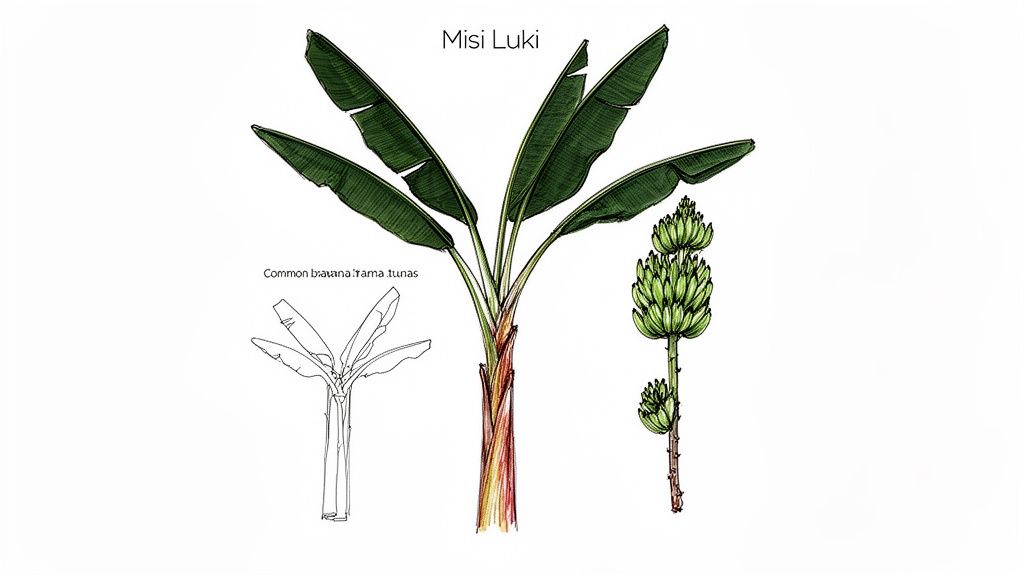
Forget the chunky, familiar Cavendish banana plant you might be picturing. The Misi Luki has a much more refined and elegant structure. By paying close attention to its pseudostem, leaves, and eventually, the fruit, you’ll have all the clues you need. Honestly, starting with the correct plant is the most important first step you can take.
To make things a bit easier, here’s a quick rundown of what to look for.
Misi Luki Banana at a Glance
Use this table as a quick reference to the key features and growing needs of the Misi Luki banana, helping you confirm its identity and suitability for your garden.
| Characteristic | Description |
|---|---|
| Common Name | Misi Luki, Lady Finger Banana |
| Pseudostem (Trunk) | Slender and graceful, often with reddish-brown marks or a waxy, bluish coating. |
| Height | Up to 4 metres, but often more compact. |
| Leaves | Narrower and more elongated than other varieties; deep, lush green. |
| Canopy | Tidy, upright, and arching silhouette. |
| New Leaf Colour | May have a reddish or bronze tinge on the underside before unfurling. |
| Fruit Size | Small, thin, and short—a true ‘Lady Finger’ type. |
| Fruit Bunch | Very tight, dense bunches (hands) with fruit pointing upwards. |
| Ripe Fruit Skin | Thin and bright yellow. |
This table gives you the essential checklist, but let's dive into the details so you know exactly what you’re seeing out in the garden.
The Trunk and Stature
The first clue is the pseudostem—what we all think of as the plant’s ‘trunk’. On a Misi Luki, this part is noticeably slimmer and more graceful than many other banana varieties. As it matures, it often develops subtle, attractive reddish-brown markings or a waxy, bluish bloom, which really adds to its good looks.
Its overall height is another key sign. While it can reach up to four metres in perfect conditions, it generally keeps a more compact form. This makes it a fantastic choice for smaller New Zealand gardens where every bit of space counts.
Leaf and Canopy Shape
Next up, have a good look at the leaves. Misi Luki leaves are a deep, lush green, but they are typically narrower and more elongated compared to the broad leaves you’d see on a Cavendish. This gives the whole plant a slightly more delicate and less imposing canopy.
You'll also notice the leaves grow in a tidy, upright, arching manner, creating an elegant silhouette. A neat little tell-tale sign is when a new leaf emerges; it often has a slight reddish or bronze tinge on its underside before it fully unrolls and turns completely green.
Identifying a Misi Luki is like learning to spot a specific bird; at first, they all look similar, but soon the unique colours, shapes, and sizes become obvious. The combination of a slender pseudostem, narrower leaves, and compact fruit is your signature confirmation.
The Defining Feature Fruit
Of course, the most definitive trait of a Misi Luki is its fruit. The bananas themselves are small and slender, living up to their ‘Lady Finger’ name. They are clearly shorter and thinner than the standard banana you’d grab at the supermarket.
These small fruits grow in very tight, dense bunches, often called ‘hands’. The whole bunch is compact, and the individual bananas point upwards as they grow. Once ripe, they’ll turn a beautiful bright yellow, and their thin skin peels back to reveal that sweet, creamy flavour this variety is famous for.
Creating the Perfect Microclimate in Your NZ Garden

Getting a Misi Luki to thrive in New Zealand really comes down to one thing: creating a warm, sheltered haven for it. While this variety is tougher than most when it comes to the cold, it still dreams of the tropics. If you want that delicious fruit, you need to give it a cosy bubble that feels like home.
This means scouting out the warmest, most protected spot in your garden. For most of us Kiwis, that’s going to be a north-facing position tucked up against a house wall or a solid fence. These structures are your secret weapon. They soak up the sun’s warmth all day and radiate it back out at night, keeping your plant a few degrees warmer and shielding it from those bitter southerlies.
Nailing this microclimate is the first big win. Once you’ve got the location sorted, it’s time to build the perfect foundation right under its roots.
Crafting the Ideal Soil Recipe
Bananas are absolute gluttons. They’re heavy feeders and even heavier drinkers, so your soil has to be up to the task. Boggy, heavy clay is a complete non-starter—the roots will simply rot. Your mission is to create a soil that’s both loaded with nutrients and drains like a champion.
Think of it like mixing the ultimate garden smoothie for your Misi Luki. You’ll want to blend your existing garden soil with a generous helping of good organic matter.
- Compost: This is your number one ingredient. It packs the soil with nutrients, improves the texture, and helps hold moisture without turning into a swamp.
- Aged Manure: Well-rotted manure is a fantastic slow-release source of nitrogen, which is exactly what your banana needs for big, lush leaves.
- Sand or Pumice: If you’re working with heavy clay, mixing in some sand or pumice is a game-changer. It opens up the soil structure and stops water from pooling around the roots.
You’re aiming for a soil pH that’s slightly acidic to neutral, somewhere in the 5.5 to 7.0 range. A simple soil test kit from a garden centre can tell you where you’re at and if you need to make any tweaks.
Watering and Feeding for Success
With the perfect spot and the perfect soil, the last pieces of the puzzle are water and food. From spring through to autumn, your Misi Luki is going to be incredibly thirsty and hungry. The goal is to keep the soil consistently moist but never soggy. A good rule of thumb is to give it a deep watering whenever the top few centimetres of soil feel dry to the touch.
Feeding is just as critical. The secret to encouraging a big bunch of bananas is a balanced fertiliser that’s rich in potassium. Potassium is the key that unlocks fruit development and boosts the plant's overall health.
Apply a high-potassium liquid feed every two to four weeks right through the warmer growing months of spring and summer. As things cool down in autumn, you can ease off, and stop feeding completely over winter when the plant goes dormant.
This consistent care is what builds a strong, healthy plant capable of producing those amazing bananas. Every home-grown bunch is a small victory, contributing to a growing movement here in Aotearoa. New Zealand's banana market has shown steady resilience, growing at an average annual rate of 1.2% since 2012, but we’re still almost entirely dependent on imports. This is a fantastic opportunity for home gardeners to grow their own, cutting down on food miles while enjoying the freshest fruit imaginable. You can learn more about these market trends over on IndexBox.io. Creating the perfect environment is a huge part of this exciting journey, and you can dive deeper by reading our guide to growing tropical plants in NZ.
A Practical Guide to Propagation and Plant Care

One of the most rewarding things about growing a Misi Luki is just how generous it is. Forget any complex gardening wizardry; the key to a bigger banana patch is simply knowing what to do with the new shoots, or ‘pups’, that pop up around the base of the main plant. This natural cycle makes expanding your collection incredibly straightforward.
These pups, also known as suckers, are the plant’s way of creating its next generation. By carefully separating them, you can start new Misi Luki plants from scratch, share them with friends, or just fill out your own tropical oasis. It’s a beautiful, sustainable process that keeps on giving.
Identifying the Best Pups for Propagation
Now, not all pups are created equal. If you want the best shot at a strong, healthy new plant, you need to pick what gardeners call a ‘sword sucker’. These are the prime candidates.
Here’s how to spot the difference:
- Sword Suckers (The Good Ones): Look for vigorous pups with narrow, spear-like leaves. They’re tapped directly into the mother plant's corm, giving them a serious head start to grow fast and strong once they’re on their own.
- Water Suckers (The Weaker Ones): These have broad, soft leaves that appear very early on. Their connection to the mother corm is usually quite weak, and they often struggle to make it by themselves.
Once your chosen sword sucker is a decent size—somewhere around 30-50 cm tall—it’s ready for its own adventure. This is best done during the main growing season, from late spring through to early autumn.
The rule of thumb for banana propagation is simple: choose the strong, spear-like sword suckers for a new plant that will establish itself with vigour and resilience.
Step-by-Step Pup Separation
Separating a pup just takes a sharp spade and a steady hand. The goal is to slice cleanly down between the mother plant and the pup, making sure you take a good chunk of the underground corm and its roots along with the new plantlet.
- Clear the Area: Gently move the soil away from the base of the pup so you can see exactly where it connects to the mother plant.
- Make the Cut: Grab a sharp, clean spade and make one decisive vertical cut straight down between the pup and the main pseudostem.
- Lever and Lift: Gently use the spade to lever the pup and its attached corm section free. The key here is to try and keep as many of the roots intact as you can.
- Plant Immediately: Get your new Misi Luki into its new home straight away, whether that’s a prepared spot in the garden or a pot. Make sure it's filled with quality, well-draining soil. To get the perfect foundation, check out our guide on choosing the best soil for plants.
Long-Term Patch Management
Looking after your Misi Luki patch is all about keeping a healthy rhythm. A thick layer of mulch, like bark or compost, works wonders for holding in moisture and keeping the weeds down. Every now and then, trim off any dead or yellowing leaves to keep the air flowing and the plant looking tidy.
It’s also crucial to remember that a banana pseudostem only fruits once. After you've harvested a bunch, the main stem that produced it will begin to die back naturally. The best thing to do is cut it down to ground level. This sends all the plant's energy into the next generation of suckers, ensuring your banana patch stays happy and productive for years.
Solving Common Growing Problems
Even a tough plant like the Misi Luki can have its off days. Don't stress, though. Most issues are pretty simple to diagnose and sort out. This guide will help you spot the common signs and get your banana plant back to its lush, happy self.
Think of it as learning to speak your plant's language. Yellowing leaves, for example, are one of the most common ways a plant signals that something isn't quite right. The trick is to figure out exactly what your Misi Luki is trying to tell you.
Yellowing Leaves: Nutrient Deficiency or Water Woes?
If you notice the older, lower leaves starting to yellow, the usual culprit is a nitrogen deficiency. Bananas are seriously heavy feeders, so this is just its way of saying it's hungry. A good dose of a balanced liquid fertiliser should have it looking better in no time.
But if the yellowing is more widespread and the soil feels constantly damp, you’re probably looking at an overwatering problem. This can lead to root rot, which is a much bigger deal. Always, always let the top few centimetres of soil dry out before you water again.
A simple rule for your Misi Luki banana is to feed it when it's hungry and water it when it's thirsty. Consistently soggy soil is the number one enemy of healthy banana roots.
Stunted Growth and Unwanted Guests
Is your Misi Luki looking a bit down in the dumps and not putting on much new growth during the warmer seasons? This could be a sign of cold stress, especially if it caught a surprise chilly snap. Make sure it's in the warmest, most sheltered spot you can offer. Poor, compacted soil that holds onto too much water can also seriously slow things down.
Pests can be a pain, too. Keep an eye out for these common garden invaders.
- Aphids: These tiny sap-suckers love to cluster on new growth, weakening the plant.
- Mites: Spider mites are harder to spot, but their fine webbing on the undersides of leaves is a dead giveaway. They cause the leaves to look stippled and discoloured.
For both aphids and mites, a gentle, garden-friendly insecticidal soap or a natural spray works wonders. For more detailed advice, check out our handy guide on using neem oil for plants.
Learning to solve these little problems is one of the most rewarding parts of gardening. Growing your own Misi Luki bananas taps into a wonderful push towards self-sufficiency. While New Zealand's commercial banana exports are small, the massive local demand shows what a fantastic opportunity there is for home gardeners to grow their own unique edibles, especially as we all look for ways to boost local food production. You can see more about New Zealand's banana trade on oec.world. By getting on top of these common issues, you’re not just growing a plant; you're nurturing a sustainable source of delicious fruit, right in your own backyard.
Knowing When and How to Harvest Your Bananas

This is it—the moment all your hard work and patience pays off. Harvesting your very own bunch of Misi Luki is a truly satisfying experience, but getting the timing right is crucial.
Forget what you know about supermarket bananas. You won't be waiting for these to turn a vibrant yellow on the plant. Instead, you need to keep an eye out for a few subtle clues that tell you they're ready to be cut down for ripening. Learning to read these signs is the secret to unlocking the best possible flavour and texture from your homegrown fruit.
Spotting the Signs of Readiness
Get right up close and have a good look at the individual bananas, or 'fingers', on the bunch. Your Misi Luki plant will let you know when it’s time.
Here are the three main things you’ll want to watch for:
- Plump and Rounded Fruit: The bananas will lose their sharp, angular ridges and start to look much fuller and more rounded out.
- Colour Shift: The deep, dark green will begin to soften into a paler, lighter shade of green.
- Brittle Flower Ends: At the very tip of each banana is a little dried flower. When they’re ready, this will become dry and brittle, often breaking off with just a gentle touch.
When you see all three of these signs, your bunch has hit peak maturity on the plant. It's time to harvest and bring it inside to ripen. Picking them at this stage is what allows the sugars to develop properly, giving them that signature sweet taste we're all after.
The Harvesting Process
Once you're confident the bananas are ready, the actual harvest is pretty straightforward. You’ll need a sharp knife or a small saw for the job.
The idea is to cut the entire stalk holding the bunch—known as the peduncle—about 15-20 cm above the top 'hand' of bananas. This leaves you with a perfect "handle" to carry the heavy bunch and hang it up.
After you've made the cut, take the bunch to a cool, dark, and well-ventilated spot. A garage or a sheltered porch usually works a treat. Hang it up by the stalk you left behind; this allows air to circulate freely around the fruit, ensuring the bananas ripen up slowly and evenly over the next one to two weeks.
Then comes the best part. As they ripen to a beautiful yellow, you can finally enjoy the incredible flavour of your Misi Luki. Their sweet, creamy taste is amazing in smoothies, sliced over your breakfast, or just eaten on their own as a well-earned treat straight from your own backyard.
Your Misi Luki Questions, Answered
Got a few lingering questions? Perfect. Let's run through the most common things people ask when they're getting to know their Misi Luki.
How Long Until I Get Bananas?
With a bit of love in a warm, sheltered spot, you can realistically expect your first bunch of bananas within 18 to 24 months of planting. If you're up north where it's a bit warmer, you might even see them sooner. For those of us in cooler spots, it might just take a little more patience for the plant to properly mature.
Can I Actually Grow a Misi Luki in a Pot?
You absolutely can. Its more compact size makes it a brilliant candidate for growing in a container. Just be sure to pick a big one – think at least 50-70 litres – and make sure it has plenty of drainage holes so the roots don't get waterlogged. Keep in mind that potted plants dry out faster and need more regular watering and feeding, especially through the big growth spurts in spring and summer.
How Do I Protect It From Frost?
While it’s tougher than many other bananas, the Misi Luki is definitely not a fan of frost. A decent frost will burn its leaves and can really knock its growth back. If you live somewhere that gets frosts, your best bet is to plant it in a cosy microclimate, like up against a north-facing wall that soaks up the sun's heat. For those really bitter winter nights, a good quality frost cloth draped over the plant can make all the difference, keeping it safe and ready to leap back into action come spring.
Ready to start your own tropical adventure? Find your perfect Misi Luki banana plant and everything else you need for your garden at Jungle Story. Explore our full collection today at https://junglestory.co.nz.